The Ninth Circuit Draws a Line. Why Trump’s 2025 Guard Deployment Was Ruled Unlawful

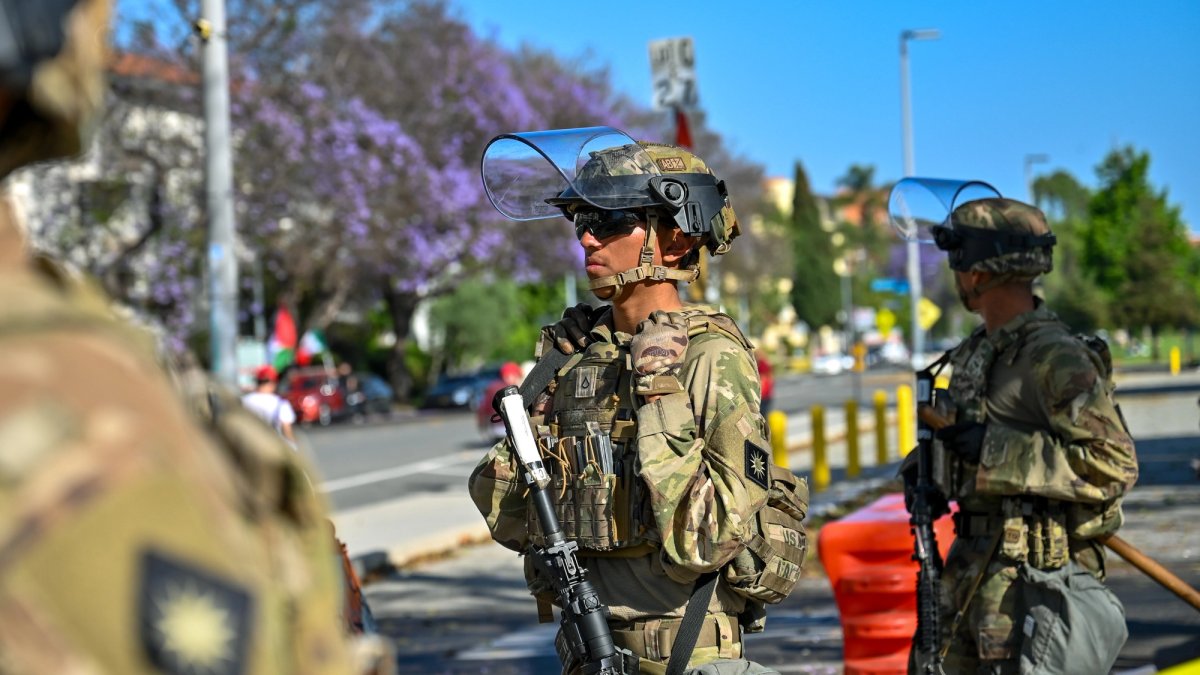
On October 23, 2026, the Ninth Circuit affirmed a lower court ruling that President Trump’s June 2025 order federalizing the California National Guard exceeded his authority. In the 2-1 majority opinion, the president’s order “exceeded the President’s statutory authority and encroached on Congress’s calling forth power, in violation of the constitutional separation of powers.”

Where This All Began
In response to raids by federal immigration forces, on Friday, June 6, 2025, about 500 people marched through downtown Los Angeles holding signs and flags. The march followed a rally by the Coalition for Humane Immigrant Rights (CHIRLA) on Los Angeles Street earlier in the day, arriving at the Roybal Federal Building and the Metropolitan Detention Center in the afternoon. When a small number of the protesters began to deface the detention center with graffiti, the bulk of the protesters moved away from that location and resumed their protest peacefully at the Roybal Federal Building.
As the day wore on, however, several of the protesters turned violent by throwing rocks at police, blocking the entrances to the facility, and continuing to paint graffiti. That prompted Los Angeles Police to declare an “unlawful assembly” and order protesters to disperse or be subject to arrest. Hours later, the mayor had imposed an overnight curfew. Protests continued in the Westlake District of the city on Saturday, June 7. That same day, June 7, 2025, President Trump ordered 2,000 California National Guard troops into federal service for 60 days, and they began arriving in Los Angeles the following day, Sunday. President Trump based his order on 10 USC 12406, which grants authority to federalize the National Guard under three conditions: (1) invasion or threat of invasion, (2) a rebellion, or (3) when the president is unable to execute the laws with regular forces.
The arrival of 300 federalized National Guard troops prompted another round of protests on June 8, under Joint Task Force 51. Protesters clashed with police and soldiers throughout the afternoon and evening hours, mostly near the Metropolitan Detention Center downtown. There were several reported incidents of damage to private property, including the now famous photos of the Waymo vehicles on fire. Federal troops in LA eventually rose to 4,000 Guard and 700 Marines.
That same day, California Governor Gavin Newsom wrote a letter to the Secretary of Defense objecting to the president’s order because it was not issued through the governor’s office as required by law, and that local authorities had the situation in hand and had not requested federal forces.
In the letter, Newsom wrote, “State and local authorities are the most appropriate ones to evaluate the need for resources to safeguard life and property. Indeed, the decision to deploy the National Guard, without appropriate training or orders, risks seriously escalating the situation.”
Also on Sunday, June 8, the Pentagon ordered approximately 500 Marines to “prepare to deploy” from nearby 2nd Battalion, 7th Marines at the Marine Corps Air Ground Combat Center in Twentynine Palms, California. The first contingent of Marines arrived in Los Angeles the next day and, after some training, took up positions around federal buildings on June 13.
The Governor took the President to court on June 9. Local city and county police had largely contained the protests by June 9, and there were no protests reported on June 12. The Mayor progressively shortened the curfew before lifting it entirely on June 17. On Monday, June 16, Mayor Karen Bass cited “successful crime prevention and suppression efforts” by city and county law enforcement in restoring order. The Guard participated in other smaller law enforcement operations, including assisting federal agents on raids at a large marijuana growing operation 130 miles from Los Angeles.
The Fight in the Courts
Newsom’s lawsuit named three objections to the president’s actions: violation of Posse Comitatus, violation of the Tenth Amendment, and the Pentagon’s failure to follow the procedures laid out in the 10 USC 12406 statute.
The courts almost immediately sided with the Governor in determining the president’s order did not meet the statutory requirements of 10 USC 12406. While denying an “immediate relief” stay on June 9, District Court Judge Charles Breyer granted a Temporary Restraining Order on June 12 that returned the California National Guard to state control. Breyer cited three reasons for granting the TRO were that Governor Newsom was likely to win on the merits, namely: (1) the president’s order did not meet the requirements in 10 USC 12406, (2) the president did not follow the procedure in the statute and therefore violated the Tenth Amendment, and (3) the mission of the federalized forces was unlawful as it violate the Posse Comitatus Act (18 USC 1385). The Administration appealed to the Ninth Circuit.
On June 19, in a per curiam judgment, the Ninth Circuit stayed (set aside) Breyer’s TRO pending a hearing on the merits of the case. This set the stage for the governor and the president to make their case before the Ninth Circuit. In August, a three-day bench trial in San Francisco on Posse Comitatus claims was decided in the governor’s favor. Subsequently, Breyer issued a Partial Judgment in favor of the governor on September 2, concluding that the president did violate the Posse Comitatus Act. He still kept in place his stay on Newsom’s other portions of the complaint (that the call-up of the Guard met the requirements of the law) pending the results of the Ninth Circuit appeal. Since the lawsuit named three conditions for maintaining the deployment as illegal, and only the appeal regarding Posse Comitatus was complete, the Ninth Circuit’s stay of Breyer’s TRO remained in force, permitting the deployments to continue.
The two sides argued their case in front of the appellate court on October 22, 2025, but the Ninth Circuit’s decision would not come for another year. In the meantime, the Pentagon extended the deployments several times. Meanwhile, the Pentagon gradually scaled back the deployment and issued extensions for the remaining 300 California Guard soldiers still deployed in Los Angeles. California challenged the extensions, and because those extensions were “new government actions”, the District Court did not need to wait for the Ninth Circuit to rule. On December 10, 2025, Judge Breyer ordered an end to the deployment, setting a deadline five days later. Guard troops departed Los Angeles by the deadline.
The California case would be influenced by a similar case that made its way to the Supreme Court. A few days after Judge Breyer’s order ended the Guard deployment in Los Angeles, the Supreme Court ruled in Trump v. Illinois on the definition of “regular forces.” The Governor of Illinois had protested the federalization of his own Guard, as well as the deployment of another 200 Texas National Guard troops to Chicago. The administration based its authority for this deployment, as well as the deployment of National Guard to Portland, Oregon, on the order to send troops to Los Angeles. A federal judge in Chicago blocked the deployment within days, and the Administration appealed. In a 6-3 ruling on December 10, 2025, SCOTUS ruled that “regular forces” means “likely refers to the regular forces of the United States military.” In making this ruling, the Court held that President Trump did not have the authority under 10 USC 12406 to federalize the Guard. Subsequently, President Trump announced the withdrawal of federalized National Guard troops from Chicago, Portland, and Los Angeles.
The Ninth Circuit issued its final opinion on October 23, 2026, affirming the District Court’s order that,
"The [deployment] order exceeded the President’s statutory authority,” and “encroached on Congress’ 'calling forth' power in violation of the separation of powers.”

What National Guard Members Need to Know
The National Guard operates as the military arm of each state, with the Governor as commander-in-chief. The Guard can and has been deployed for both state and federal missions, and so Guard commanders are well schooled on what authorities they have under Title 10 (federal orders) and Title 32 (state orders). In the court cases that followed the initial orders to the State Adjutant Generals, the decisions clarified several points on the separation of powers between the state and the federal government, as well as between Congress and the Executive.
The courts have closed 10 USC 12406 as an avenue for federalizing the National Guard again, except under the narrow criteria in the statute. The Circuit Courts have enforced the process, and authorities rightly belong to the state when those criteria are not met, and SCOTUS has closed the idea that “regular forces” can include the Guard. That statute is intended to be used in times of very specific circumstances such as rebellion or invasion, and the courts ruled that the protests last summer did not rise to that level.
Continue Reading

25+ Things to Do Near Tyndall AFB in Panama City, Destin, and More
Welcome to Tyndall Air Force Base! Your Guide to Base Access, Amenities, and More

35+ Things to Do Near Dobbins Air Reserve Base in Marietta, Atlanta, and More!
Join the Conversation

Mickey Addison
Military Affairs Analyst at MyBaseGuide
Mickey Addison is a retired U.S. Air Force colonel and former defense consultant with over 30 years of experience leading operational, engineering, and joint organizations. After military service, h...
Mickey Addison is a retired U.S. Air Force colonel and former defense consultant with over 30 years of experience leading operational, engineering, and joint organizations. After military service, h...
Credentials
- PMP
- MSCE
Expertise
- defense policy
- infrastructure management
- political-military affairs
SHARE: