Trump Orders Navy to Rip Out Electromagnetic Catapults on Next Ford-Class Carrier

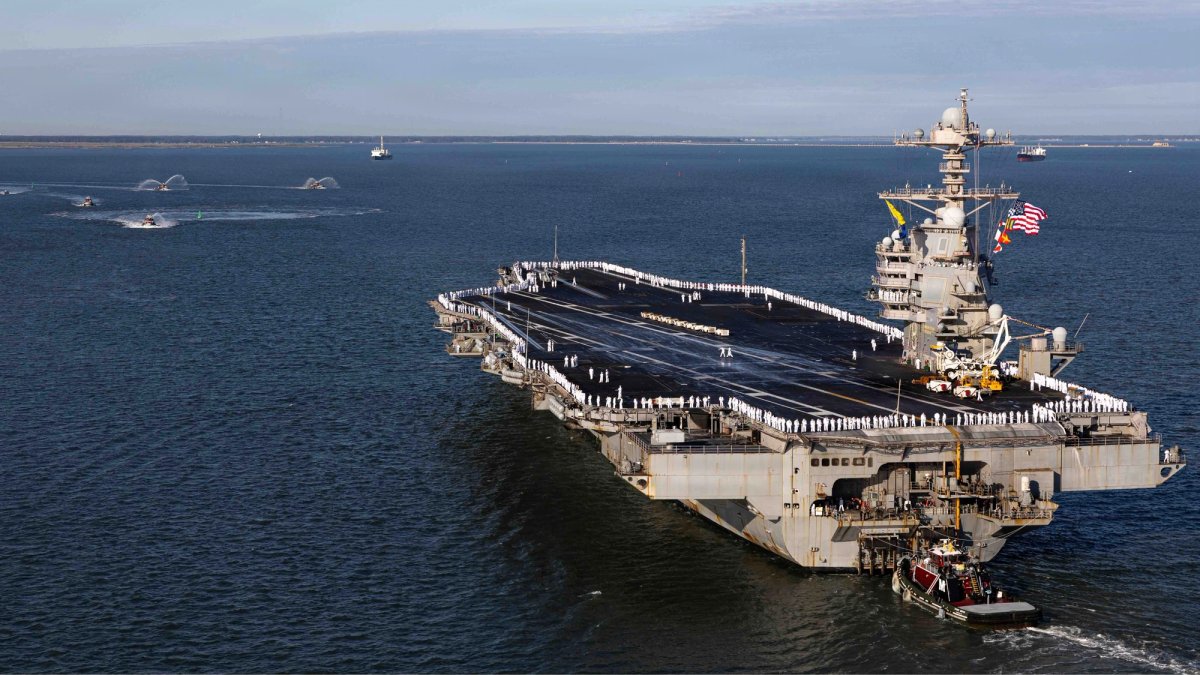
President Donald Trump has ordered the Department of Defense to draw up a plan for tearing the Electromagnetic Aircraft Launch System and Advanced Weapons Elevators out of the still-under-construction aircraft carrier Doris Miller (CVN-81) and replacing them with the steam catapults and hydraulic elevators the Navy retired a generation ago.
The directive is contained in a presidential memorandum, "Rebuilding the United States Navy and America's Shipbuilding Industrial Base," that Trump signed on August 13, 2026, and addressed to the Secretary of Defense, the Director of the Office of Management and Budget, and the Assistant to the President for National Security Affairs. Section 2 of the memorandum gives the Secretary of Defense 60 days to deliver,
"...a plan on the required measures to replace the Electromagnetic Aircraft Launch System and Advanced Weapons Elevators with steam and hydraulic systems for the construction of CVN-81, including timelines and resourcing requirements."
The White House's accompanying fact sheet confirms the same instruction in nearly identical language, adding no further detail on cost, engineering rationale, or how a mid-construction swap would be executed.
The order revives a fight Trump has waged with the Navy's carrier engineers since his first term. He complained publicly as far back as 2017 that the electromagnetic system installed aboard the lead ship of the class, USS Gerald R. Ford, was too complicated, telling reporters during a shipboard visit that operators would have "to be Albert Einstein to figure it out" and, in a separate interview, that the system was "not good" and lacked the "power" of the steam catapults it replaced.
He returned to the subject in an address to service members and, more recently, at a defense event at the Army War College in Carlisle, Pennsylvania, where he told the audience the Navy would no longer build ships with, in his words, "the ridiculous billions of dollars more they spent on electric catapults, and they're not good."
What the Memo Actually Requires
The provision on EMALS is only two sentences inside a much larger memorandum aimed at overhauling Navy shipbuilding. Notably, the document also authorizes a "Finland Model" that would let foreign shipbuilders build American warships domestically in exchange for technology transfer and workforce investment; directs plans for a competitive acquisition approach to new surface combatants, CONSOL tankers, and Roll-On/Roll-Off vessels; orders a study for a fifth public Navy shipyard sized for the planned growth of the fast-attack submarine fleet; calls for a new Component Repair Center for submarine parts; and directs a review of the Naval Sea Systems Command aimed at speeding delivery and curbing what the memorandum calls "iterative design change procedures."
Section 3(c) explicitly bars the Navy from making further design changes to the ship classes covered by the memorandum without sign-off from the Secretary of Defense, in consultation with the Secretary of the Navy, OMB, and the national security adviser.
Notably, the document the President signed is a memorandum, not an executive order, though the White House and much of the press have described it in shorthand as an order or directive. It carries the same practical instruction to executive branch officials but does not carry the formal numbering or Federal Register publication of an executive order.

A Carrier Already Half-Built
CVN-81 is under construction at Huntington Ingalls Industries' Newport News Shipbuilding yard in Virginia, the fourth ship of the Ford class after Gerald R. Ford, John F. Kennedy, and Enterprise. According to the Congressional Research Service's most recent update on the Ford program, the Navy's budget submission estimates CVN-81's total procurement cost at roughly $15.2 billion, with delivery not expected until February 2032 under the program's own timeline.
USNI News has reported that it is now likely to slip roughly two years, to 2034, because of shipyard capacity constraints tied to delays on the preceding hull, CVN-80 Enterprise. Todd Corillo, a spokesperson for Newport News Shipbuilding, said in a statement reported by USNI News that
"CVN-81's construction schedule has been affected by the cascading impact of CVN-80 delays on shipyard footprint capacity," while shipyard president Kari Wilkinson said the ship's units "continue to move through steel fabrication and outfitting in support of the keel laying later this year."
General Atomics, which holds the roughly $1.2 billion contract to build EMALS and the Advanced Arresting Gear for Doris Miller, pushed back on the order directly. In an August 17 press release, the company argued that the system's combat record undercut the case for scrapping it,
"Given CVN 78's successful operational performance, record 326-day deployment and receipt of a rare Presidential Unit Citation for the Carrier Strike Group's role in Operation Epic Fury, the decision not to proceed with EMALS on CVN 81 warrants careful reconsideration. With nearly 50% of production complete, changing course now would introduce significant cost, schedule, and integration risks."
The reference is to Gerald R. Ford's record-setting deployment, the longest by a U.S. carrier in more than fifty years, during which the strike group conducted combat operations against Iran under Operation Epic Fury and was subsequently awarded a Presidential Unit Citation, a distinction rarely given to a carrier strike group.
The statement went further, warning that the reversal "will have broader implications for carrier readiness, national security, and U.S. technological superiority, potentially creating opportunities for adversaries to close the capability gap," and noted that abandoning the program mid-construction cuts against the memorandum's own stated goal of stabilizing the defense industrial base at a moment when "workforce stability, production capacity, and the ability to sustain critical technologies" are increasingly vital.
General Atomics' statement was among the only on-the-record reactions from a party directly affected by the order; the Navy has not yet released a cost estimate of its own, and that figure is precisely what Section 2 tasks the Secretary of Defense with producing within 60 days.

The Reliability Record Behind the Complaint
Trump's skepticism of EMALS is not without a documented basis, even if his prescribed fix is disputed. The system has struggled to meet its reliability targets for more than a decade. In 2015 testimony to the Senate Armed Services Committee, then-Director of Operational Test and Evaluation Michael Gilmore reported that EMALS was demonstrating roughly 340 mean cycles between critical failure in shipboard testing, against a Navy requirement of 4,166 cycles and a minimum acceptable threshold of 1,250.
He told the committee that "the data currently available to my office indicate EMALS is unlikely to achieve the Navy's reliability requirements," and delivered a similarly blunt assessment of the Advanced Arresting Gear, warning that without substantial improvement, the carrier "likely will not be able to complete a normal day of flight operations."
A decade later, the problems have not fully resolved. The Pentagon's independent testing office, in its most recent annual assessment of CVN-78 Gerald R. Ford following the carrier's 2025 deployment, found that
"Despite engineering upgrades to hardware and software, reliability has not appreciably changed from prior years, and reliance on off-ship technical support remains a challenge."
The same report concluded that "the reliability and maintainability of CVN 78's EMALS and AAG continue to adversely affect sortie generation and flight operations, which remains the greatest risk to demonstrating operational effectiveness and suitability" in the ship's ongoing operational testing. The Advanced Weapons Elevators, also targeted by the memorandum, fared little better: the report noted the crew
"...conducted 11,369 AWE runs, moving 1,829,580 pounds of ordnance to the flight deck" during the deployment, but that "the Navy has yet to build and transfer ordnance to the flight deck at rates reflective of the Design Reference Mission."
Those figures give the White House's underlying complaint about reliability a genuine evidentiary basis. What they do not settle is whether reverting to 1950s-vintage steam technology, rather than continuing to mature the electromagnetic systems, is the right remedy.

Steam vs. Electromagnetic: What the Critics Say
Retired Navy Rear Admiral Mark Montgomery, now a senior fellow at the Foundation for Defense of Democracies, called the proposed reversal "illogical, inefficient and a waste of money," adding that it "would be foolish and expensive to revert to steam catapults."
Bryan Clark, a senior fellow at the Hudson Institute and a former Navy submarine officer who has advised the service on force structure, told reporters that the electromagnetic systems "have proven themselves to be easier to operate and less expensive in terms of personnel and maintenance," estimating that the Navy has saved roughly $100 million a year in operating costs on Ford-class carriers compared with steam-powered Nimitz-class ships.
Clark separately estimated that restarting steam catapult production would itself cost tens of millions of dollars before any shipboard installation began, and that a full CVN-81 redesign "will probably be into the billions."
Veteran naval affairs journalist Chris Cavas, a longtime chronicler of Navy shipbuilding, described the memorandum's approach as "very old thinking, very outdated," and noted that pilots who have flown off both systems report the electromagnetic launch is noticeably smoother, "much less stress on the aircraft," than the more abrupt jolt of a steam shot.
The criticism has not been confined to defense analysts. Senator Mark Kelly of Arizona, a retired Navy captain and combat pilot who has personally catapulted off carrier decks "hundreds of times," told reporters he found the President's intervention in ship engineering baffling on its face, regardless of the merits of either system:
"Donald Trump knows nothing about this stuff. Not in any world would I suggest to the Navy how to engineer specific systems on a ship at this point."
Kelly, who also flew as a NASA astronaut and holds an engineering degree, argued the decision illustrated a broader concern about a president directing granular technical decisions typically left to service engineers and program managers.
Precedent from an allied navy offers a cautionary data point on cost, even though it involves a different launch technology entirely. When the United Kingdom briefly considered converting one of its Queen Elizabeth-class carriers from a ski-jump configuration to a catapult-and-arresting-gear design in the early 2010s, projected costs rose from an initial estimate of roughly £800 million ($1.08 billion) to nearly £2 billion ($2.71 billion) before the plan was abandoned; Britain's National Audit Office later found the abandoned conversion work alone had cost taxpayers about £74 million ($100.27 million).
No comparable government estimate yet exists for reverting CVN-81 to steam, which is precisely the gap the memorandum's 60-day plan is meant to fill.
What Happens Next
For now, the memorandum leaves the most consequential numbers unanswered. It does not specify whether the Navy would attempt to retrofit propulsion steam lines into a hull design engineered around the Ford class's electric plant, whether General Atomics would be compensated for work already performed and discarded, or how a redesign would affect the ship's already-slipping delivery date.
Those questions fall to the Secretary of Defense's mandated 60-day report, due in mid-October, which must go through the Office of Management and Budget and the national security adviser before reaching the President's desk.
Congress, which will ultimately be asked to fund whatever plan emerges, has not yet weighed in through committee action, though the reaction from lawmakers with Navy or engineering backgrounds, including Kelly, suggests the proposal will face scrutiny on Capitol Hill as well as in the fleet.
The broader memorandum's shipbuilding reforms have drawn comparatively less public attention than the catapult provision, in part because they address capacity and industrial-base problems that both parties in Congress and most naval analysts agree are real and urgent. The steam catapult order is different: it targets a genuine, well-documented reliability problem but does so with a fix that the engineers, historians, and former officers who have spoken publicly so far do not believe will solve it, and that most agree will add years and billions of dollars to a program already running behind schedule.
Continue Reading

How to Cast Your Military Absentee Ballot: Step-by-Step Guide for Service Members
Planning Your Military Career? Why You Should Lock in Life Insurance Early
Free Wi-Fi in the Barracks is Finally Here (And the Marines Got It First)
Join the Conversation

Mickey Addison
Military Affairs Analyst at MyBaseGuide
Mickey Addison is a retired U.S. Air Force colonel and former defense consultant with over 30 years of experience leading operational, engineering, and joint organizations. After military service, h...
Mickey Addison is a retired U.S. Air Force colonel and former defense consultant with over 30 years of experience leading operational, engineering, and joint organizations. After military service, h...
Credentials
- PMP
- MSCE
Expertise
- defense policy
- infrastructure management
- political-military affairs
SHARE: