Coast Guard Basic Training: Everything You Need to Know

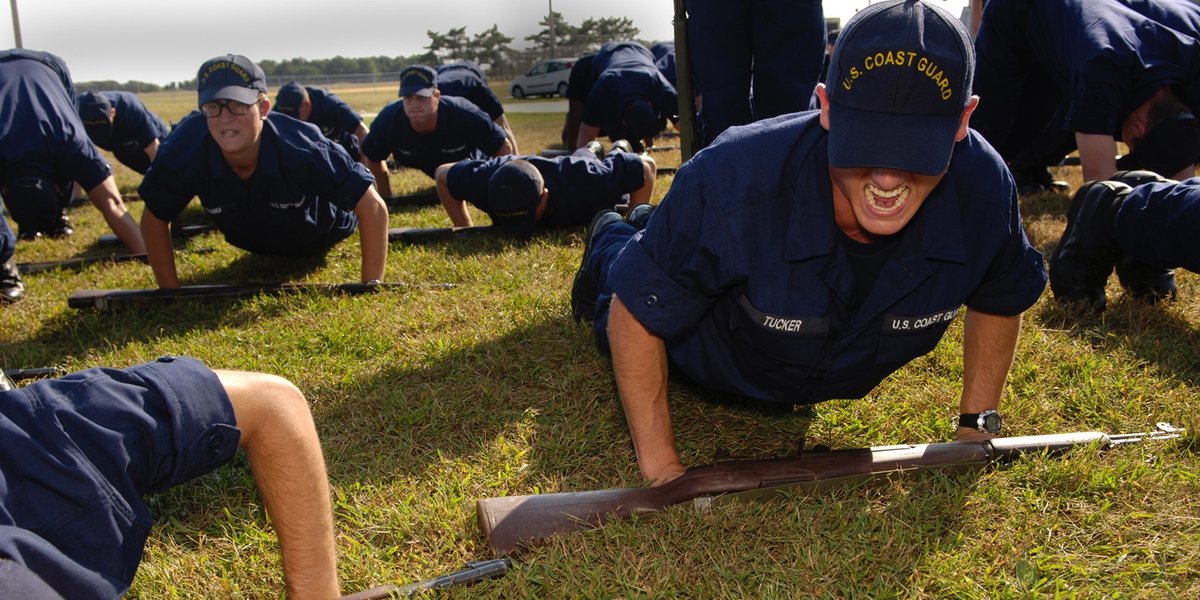
Hooyah, future Coast Guardsmen! The Coast Guard saves lives, enforces laws, and operates in conditions that would stop most people cold. Joining its ranks means proving you belong — both physically and mentally — through eight weeks of intense basic training in Cape May, New Jersey. Whether you're just starting to consider enlisting or your ship-out date is already locked in, this guide will walk you through everything you need to know. Family members, your section is at the end.

Coast Guard Basic Training Requirements
A base level of physical fitness is expected of all recruits. Note that men and women have different physical fitness expectations.
Men
- 29 push-ups in one minute
- 38 sit-ups in one minute
- 1.5-mile run in less than 12:51
- 16.50” sit and reach
- Complete a swim circuit
- Tread water for five minutes
- Swim 100 meters (~328 feet) after jumping off a 6-foot platform
Women
- 15 push-ups in one minute
- 32 sit-ups in one minute
- 1.5-mile run in less than 15:26
- 19.29” sit and reach
- Complete a swim circuit
- Tread water for five minutes
- Swim 100 meters (~328 feet) after jumping off a 6-foot platform
If you’re not an exceptionally strong swimmer, the Coast Guard does offer extra swim training to help you prepare for your career as a Coast Guardsman.
However, you should probably make sure you can at least stay afloat before attempting to join the Coast Guard. It’s common sense! In addition to physical requirements, you must meet the following basic requirements to be able to join:
- You must be a U.S. citizen or full-time resident alien.
- You must be between the ages of 17 and 31.
- You must have a high school diploma (GEDs are accepted in exceptional circumstances).
- You can have no more than three dependents.
- You’ll need to pass the Armed Services Vocational Aptitude Battery (ASVAB) test.
- You must pass the basic entrance medical exam.
How Long Is Coast Guard Basic Training?
Coast Guard basic training lasts for eight weeks. The process is full of both physical and mental conditioning, so you better be prepared!
Where Is Coast Guard Basic Training?
Coast Guard basic training is performed at the Training Center Cape May (TRACEN Cape May) in Cape May, New Jersey. Cape May is at the southernmost tip of the Garden State, where the Delaware Bay meets the Atlantic Ocean.
It’s the only enlisted boot camp in the entire Coast Guard, meaning every single enlisted Coast Guardsman has walked the same groups you’re about to.
Do You Get Paid for Basic Training?
Yep! All Coast Guard recruits receive pay for Coast Guard basic training.
You’ll usually be paid as an E-1, which would get you somewhere around $2,407.20 per month (just over $28,800 per year) as of 2026.
That’s why you need to set up a bank account with direct deposit before you leave — your pay will be automatically deposited throughout training.
Also, make sure you have at least $300 already in your account when you arrive, as you’ll be required to purchase some items before your first paycheck.
Which Military Branch Is Right for You?
Answer 10 questions to discover which branch of the U.S. Armed Forces best matches your personality, interests, and goals.
10 questions • Takes about 2 minutes
What to Bring to Coast Guard Basic Training
You NEED to bring a state-issued ID, like your driver’s license, and a direct deposit form from your bank. There are a few items that you’re recommended to bring to Coast Guard basic training.
- A multi-pack of white, V-neck shirts
- 6 pairs of black dress socks (non-blistery type)
- 10+ pairs of underwear
- Toothbrush
- A basic analog or digital watch (no smartwatches allowed)
- Up to $50 in cash to use at the exchange
- An address book with stamps
- Hair ties or bobby pins (for women)
- Feminine products (for women)
- Neutral-colored sports bras (for women)
The Coast Guard will provide many things for you at boot camp, so you don’t have to worry about packing them. These include:
- Toothpaste
- Soap
- Shampoo
- Deodorant
- Towels
- Shower shoes
- Blister kit
- Laundry bags
- Tennis shoes and socks
- Water bottle
- Paper and pens

Coast Guard Basic Training Phases
So, what is basic training like? We won’t lie; it’s tough.
Before you hop into Coast Guard basic training, it might be a good idea to prepare yourself at home. You definitely don’t want to be that recruit who’s always falling behind or failing every physical fitness test.
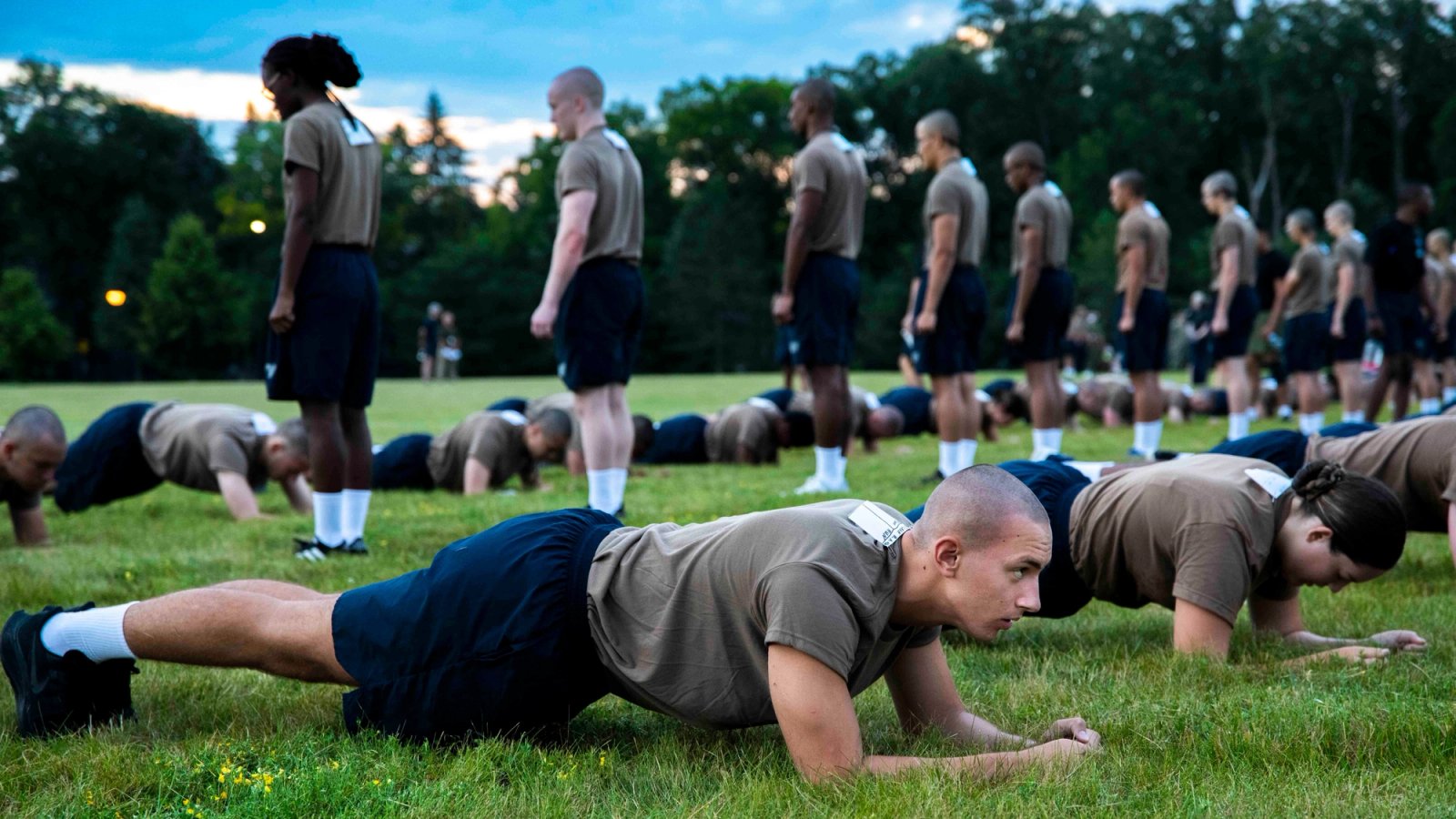
If you haven’t already, come up with a challenging workout routine for yourself. Throw in jogging, strength training, and swimming (prioritize practicing swimming before you get there).
Don’t underestimate the importance of your local recruiter. They’ve quite literally been there, done that, so they can answer all your questions, small or large.
Think about where you might want to serve after training, and look through a Coast Guard job list to see what kinds of careers in the Coast Guard might suit you best.
Day One
Your Coast Guard journey officially begins before you ever set foot in Cape May. Recruits from across the country muster 97 miles away at the USO Center in Terminal D of Philadelphia International Airport (PHL).
Once you land, retrieve your bags and report to the USO immediately. Volunteers there will provide meals, answer questions, and help you get ready for what’s ahead. Take advantage of this time — it’s your last bit of calm before the storm. Make any final phone calls to family and friends, because personal phone calls will not be permitted once training begins (limited phone privileges are only earned in the final two weeks). Then, board the bus to Cape May.
When the bus arrives at the Recruit Processing Center at Cape May, the forming process begins immediately. A Company Commander in a distinctive campaign cover (“Smokey Bear” hat) will greet you the moment the bus doors open — and the intensity starts right there. No matter what time you arrive, your first day will not end until approximately 0030. Get plenty of sleep in your final days as a civilian, because once training starts, you’ll be up again at 0530.
During in-processing, all personal belongings will be searched. Anything not on the approved items list will be confiscated and held until graduation — anything on the contraband list could end your training career before it starts. You’ll fill out a significant amount of paperwork, and male recruits will receive their mandatory haircuts.
You’ll also receive your first uniform issue and a copy of The Helmsman, the official boot camp guide that contains all the required knowledge you’ll need to pass exams. Any downtime you have should be spent reading it. You’ll also receive a postcard to mail to your family with your mailing address and company information.
Week One
The next few days are a continuation of in-processing, including medical and dental screenings, vaccinations, and a urinalysis test. About three days after arrival, your Recruit Training Company will officially form, and you’ll meet your Company Commander (CC) — the person who will have the greatest influence on your transformation from civilian to Coast Guardsman.
After forming into your Recruit Training Company (which happens about three days after arrival), week one kicks into gear. You’ll take your entrance physical fitness test — failure here means you will not be able to continue training, so make sure you’re prepared.
You’ll also begin learning military drill, the Uniform Code of Military Justice (UCMJ), and Coast Guard customs and courtesies. Your CC will be your toughest critic and your greatest coach. Think of them as a demanding but fair mentor whose entire job is to turn you into a Coast Guardsman.
Week Two
Week two is where physical conditioning really kicks in. You’ll be running first thing in the morning and conducting your swim assessment to determine your swimming proficiency. You’ll also begin learning the basics of how to work as a team with your company and start classroom work covering proper saluting and rank insignias.
This week, you’ll also be introduced to your Company Mentor — an active-duty Coast Guardsman currently serving in the fleet who will meet with your company periodically throughout training to give you a real picture of what a career in the Coast Guard looks like.
Week Three
More teamwork and physical training will be going down during week three. By this time, you may be physically exhausted and at the end of your rope. Don’t quit!
Your body just needs some time to get used to the rigorous training. You can do this! At this point, you’ll likely be well-versed in military customs and proper etiquette. You’ll grow more familiar with Coast Guard drills and begin diving into essential nautical knowledge, including deck seamanship, types and parts of a line, and different kinds of knots — all critical skills for life at sea.
Week Four
You’ll take your official physical fitness test this week. By now, it should be a breeze for you! You’ll also be required to take a mid-training exam that will test you on everything you’ve learned up until this point.
This is also a pivotal week for your future — you’ll complete your Assignment Data Card (ADC), indicating your preferred duty location and unit type. Keep in mind that the Coast Guard assigns based on the needs of the service, so your preferences are taken into account, but not guaranteed.
You’ll also get an overview of the various enlisted career paths and begin learning about pay and allowances.
Week Five
By the end of this week, you’ll likely have your first official assignment in your hands. Of course, you’ll be doing as much physical conditioning as the past few weeks, too.
Weeks Six and Seven
Week six brings one of the more intense stretches of training. You’ll complete firearms training — learning firearm safety and how to properly handle and shoot at the range. In between classroom sessions and range time, recruits participate in pugil stick battles, which simulate fighting with a rifle in a safe and controlled environment.
This builds combat confidence and physical toughness. The rest of week six transitions into administrative work as you begin preparing travel plans for after graduation.
Week seven is all about ensuring you’re ready to enter the fleet. You’ll take your final exam and complete a final confidence course. Recruits who successfully meet all requirements begin turning in gear and preparing for graduation.
Note: if you don’t meet the standards required to advance, you may be sent to the Recruit Aptitude and Motivation Program (RAMP) until your Company Commander determines you’re ready to continue.
Week Eight
Week eight is the final stretch. You’ll receive detailed briefings on your military entitlements and benefits, including a CPR and first-aid review, and wrap up any remaining administrative tasks.
Recruits who have made it this far have proven to their Company Commander that they’ve met all requirements — demonstrating teamwork, physical readiness, and academic achievement. Ribbons are awarded at graduation for seamanship, leadership, academic excellence, and other areas.
Then, on Friday morning, you officially become a United States Coast Guardsman. Immediately after graduation, you’ll have five days of leave to spend with family before reporting to your first assignment.

Coast Guard Basic Training Graduation
Coast Guard basic training graduation is a proud milestone for recruits and their families. Ceremonies are typically held on Friday mornings, with a brief from the Commanding Officer at 1000 in the Ida Lewis Auditorium, followed by the graduation ceremony at 1100. Note that graduation is occasionally moved to Thursday to avoid conflicts with federal holidays.
The Training Center opens to invited family members and guests at 0815 — do not arrive early, as security will turn you away. A government-issued photo ID is required to access the base. Seating is limited, so plan to arrive right at the gate opening time.
One important difference from other military branches: the Coast Guard completes all out-processing and assignment paperwork before graduation, so recruits are free to depart Cape May immediately after the ceremony.
Family Resources
If you have a family member who’s embarking on Coast Guard basic training any time soon, you can check below for valuable resources regarding graduation attire, contacting your recruit, and what you should send them while they’re busy training to serve the country.
How to Contact Someone During Basic Training
You can send a letter to your recruit during Coast Guard basic training. Recruits will not be allowed to call home or receive calls during training. If you’re sending a letter, the address should look like this:
Coast Guard Boot Camp Mailing Address: Doe J. (last name then first initial) Company # X Hall (James, Healy, or Munro) 1 Munro Avenue Cape May, NJ 08204
If you have an emergency and need to contact a recruit in a timely manner, you will have to get in touch with your local Red Cross office. They can get a message to your recruit quickly, so you don’t have to wait for them to receive a letter via snail mail.
What Can I Send Someone During Basic Training?
You are allowed to send letters to your recruit, but you cannot send care packages or anything similar. Don’t try to send large boxes full of snacks and creature comforts because they’ll be immediately confiscated as contraband. There are many recruits and limited space, so only letters to your recruit will be allowed.
What to Wear to Basic Training Graduation
Provided you look presentable, there are no precise rules for family members looking to attend their recruit’s graduation ceremony.
Want to play it safe? Go business casual. No one will reprimand you for wearing jeans and a sweatshirt, but you might want to represent your recruit a little bit better than that.
Are You Ready?
Eight weeks. That’s all that stands between you and the title of United States Coast Guardsman. It won’t be easy — it’s not supposed to be.
The Coast Guard saves lives, responds to disasters, and enforces the law on some of the most unforgiving waters on earth. The men and women who do that work had to earn it, just like you will. Train hard before you arrive, stay mentally tough when things get difficult, and remember why you started.
The title waiting for you on the other side of graduation is worth every early morning, every grueling PT session, and every moment of doubt you push through. Semper Paratus — always ready. Are you? Apply online or contact a recruiter and sign up for Coast Guard basic training to find out!
Continue Reading
Navy Basic Training: Everything You Need to Know
Marine Basic Training: Everything You Need to Know
Everything There is to Know About the Coast Guard Reserve
Join the Conversation

Tracy Fuga
Military Spouse & Military Lifestyle Writer at MyBaseGuide
Tracy Fuga is a San Diego-based writer, editor, and marketing professional with nearly two decades of experience in content creation and communications. A former editor at MARCOA Media — the origina...
Tracy Fuga is a San Diego-based writer, editor, and marketing professional with nearly two decades of experience in content creation and communications. A former editor at MARCOA Media — the origina...
Expertise
- military spouse lifestyle
- small buisness
- entrepreneurship
SHARE: