ChatGPT Mil Goes Live, Completing DoD's Three-Vendor Bet on Frontier AI

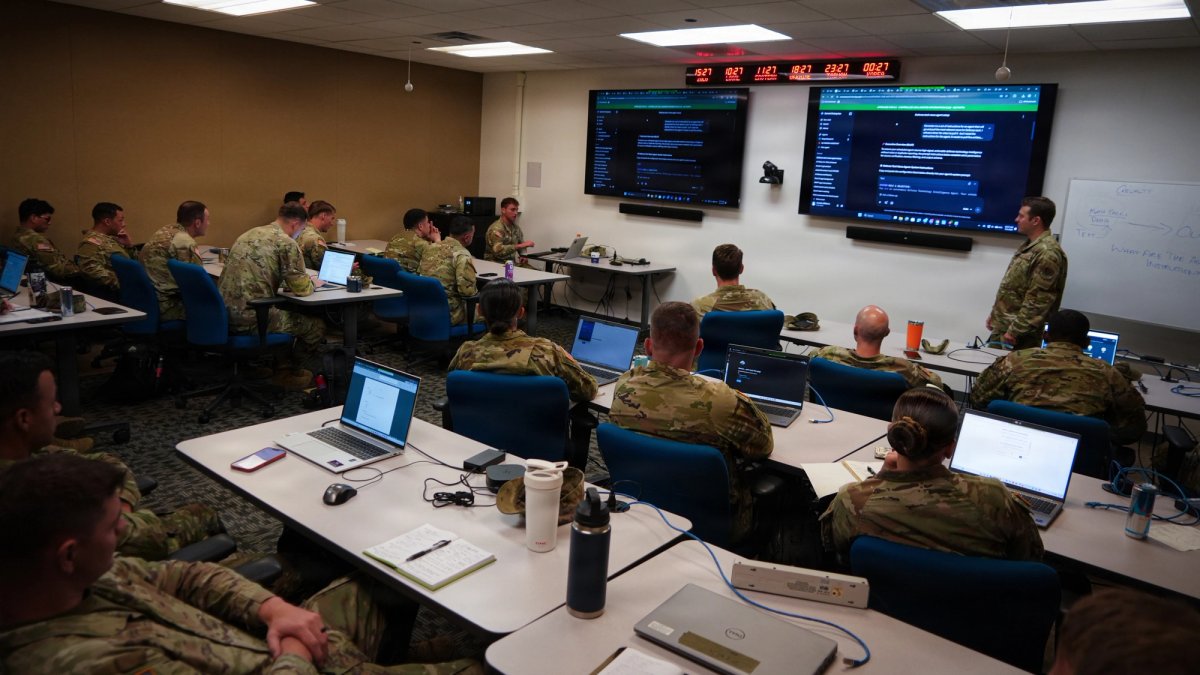
On August 31, 2026, the Department of Defense launched OpenAI's ChatGPT Mil on GenAI.mil, the department's enterprise generative AI platform, according to a DoD press release. This marks the third time a major commercial AI model family has reached the department's workforce through the platform in less than nine months, following Google's Gemini in December 2025 and xAI's Grok in early 2026.
DoD says the system is "built for scale to support more than 3 million Department personnel," according to the release.
The department describes the tool as centered on chat, file handling, project management, and custom GPTs, with more features to be added over time. Its intended use is unclassified but document-heavy work, the kind of paperwork-driven labor that consumes a large share of a garrison or headquarters staff's day.
"ChatGPT Mil brings a familiar commercial experience into the Department's secure environment, tailored to warfighter needs," the release states.
The Chief Digital and AI Office (CDAO) and the Office of the Under Secretary of Defense for Research and Engineering handled the rollout, just as they did for previous GenAI.mil expansions. DoD frames the launch as part of a broader effort, connected to the White House's AI Action Plan, to push frontier AI capability out to the Joint Force.
The Impact Level 5 (IL5) accreditation is what separates ChatGPT Mil from the commercial version. Impact Level 5 is the Defense Department's classification tier for controlled unclassified information requiring higher protection than general CUI. Vendors must typically run the workload on infrastructure separated from its commercial cloud, subject to a government-specific authorization process that can take months after a contract is signed.
Getting this green light is usually the biggest hurdle in putting a commercial AI product on a DoD desktop. Consequently, the gap between OpenAI's original contract and ChatGPT Mil's actual availability ran over a year.

From a Single Platform to a Multi-Vendor Marketplace
GenAI.mil itself is not new. DoD introduced the platform on December 9, 2025, with Google Cloud's Gemini for Government as its first available model, an event department leadership treated as a major milestone.
"I am pleased to introduce GenAI.mil, a secure generative AI platform for every member of the Department of War," Defense Secretary Pete Hegseth said, according to a DoD release.
"It is live today and available on the desktops of all military personnel, civilians and contractors."
Hegseth added that the launch marked "a giant step toward mass AI adoption across the department" and told the workforce he expected "every member of the department to log in, learn it and incorporate it into your workflows immediately."
The framing at that first launch was competitive as much as operational. Emil Michael, then serving as Under Secretary of Defense for Research and Engineering, cast the effort in terms of a race against rival powers:
"There is no prize for second place in the global race for AI dominance," he said, according to the release. "We are moving rapidly to deploy powerful AI capabilities like Gemini for Government directly to our workforce."
Hegseth echoed this, telling personnel that "AI should be in your battle rhythm every single day; it should be your teammate," and that the department was "pushing all of our chips in on artificial intelligence as a fighting force."
The Gemini rollout included IL5 accreditation for Controlled Unclassified Information, natural-language conversation, retrieval-augmented generation, and web-grounding through Google Search, along with mandatory training material posted to the platform. The AI Rapid Capabilities Cell inside the Office of Research & Engineering built the integration. Crucially, they pitched it from day one as the foundation for a multi-vendor platform, not an exclusive contract.
Other providers joined quickly. On December 22, 2025, DoD announced an agreement with xAI to bring Grok to GenAI.mil, targeting deployment in early 2026. The department described the addition as extending "an AI ecosystem built for speed, security, and decision superiority," according to the release, and highlighted one capability distinct from the Gemini offering: access to "real-time global insights derived from the X platform." Like Gemini, the Grok integration was built to IL5 certification and scoped to the same roughly 3-million-person population of military and civilian personnel.
ChatGPT Mil's arrival on August 31 completes what is now a three-vendor lineup on GenAI.mil; Google, xAI, and OpenAI each running enterprise-grade versions of their consumer-facing chatbots inside DoD's secure network, all certified to the same IL5 standard, all pitched at the same department-wide population. For a department that spent much of the past decade struggling to move commercial software into classified and semi-classified environments at any speed, three separate frontier-model integrations inside a single fiscal year represent an unusually fast acquisition and accreditation cycle.
The Vendor Missing From GenAI.mil
Notably missing from the announcements are Anthropic or its Claude models. Before Gemini, Grok, or ChatGPT ever reached the platform, Claude was the department's “go-to” AI system. In a complaint filed March 9, 2026, in the U.S. District Court for the Northern District of California, Anthropic described Claude as DoD's "most widely deployed and used frontier AI model" and said it was, at the time, "the only frontier AI model on the Department's classified systems," operating under an existing $200 million CDAO contract. It was the same contract structure OpenAI would later receive for ChatGPT Mil.
That relationship deteriorated publicly in February 2026. According to Anthropic's own statement responding to the episode, Secretary Pete Hegseth announced on the social platform X that he was "directing the Department of War to designate Anthropic a supply chain risk," a step the company said followed months of failed negotiations. The dispute centered on two conditions Anthropic had attached to Claude's use inside the department: a refusal to permit fully autonomous weapons systems operating without human oversight, and a refusal to permit mass domestic surveillance of Americans. Anthropic said those restrictions "have not affected a single government mission to date" and that it would not lift them regardless of "intimidation or punishment" from the department. This designation put Claude in the same category as Chinese and Russian software.
DoD formalized its split with Anthropic and its designation of Claude as a “supply chain risk” in early March 2026, removing Claude’s authority to operate on DoD systems. Anthropic sued the following week, naming Hegseth and several other cabinet officials as defendants and alleging the government had exceeded its statutory authority, retaliated against protected speech, and denied the company due process. On March 26, 2026, U.S. District Judge Rita Lin granted Anthropic a preliminary injunction, finding the company likely to succeed on its First Amendment retaliation claim.
"Nothing in the governing statute supports the Orwellian notion that an American company may be branded a potential adversary" over its contracting position, Lin wrote.
The litigation continued past that point. News coverage of a further ruling from the same court on August 27, 2026 reported that Judge Lin went on to call the government's evidence of an actual security risk "slim" and its actions against Anthropic "illegal and baseless."
Whatever the litigation ultimately settles about the designation's legality, the department's own public record answers the simpler question of Claude's practical standing on GenAI.mil: it has none. A model Anthropic says was, as recently as February 2026, the only frontier system cleared for the department's classified work is absent from the unclassified platform DoD built to reach "every member of the Joint Force," even as three of its competitors filled that space in less than nine months.

The OpenAI Relationship Predates the Platform
DoD's relationship with OpenAI did not begin with ChatGPT Mil. It traces back to June 16, 2025, when OpenAI launched what it calls the OpenAI for Government program, an initiative aimed at bringing the company's models into secure, compliant environments across federal agencies. According to OpenAI's own announcement of the program, the department was the flagship partner: a contract with a $200 million ceiling, awarded through CDAO, scoped to administrative operations modernization, including healthcare access, program and acquisition data analysis, and cyber defense support.
This agreement consolidated earlier, smaller OpenAI collaborations with the national laboratories, the Air Force Research Laboratory, NASA, NIH, and the Treasury Department into a single federal offering, according to OpenAI. Those prior relationships were narrower, while OpenAI for Government was pitched as the umbrella through which any federal customer, DoD included, could access ChatGPT Enterprise, ChatGPT Gov, and, in limited cases, custom models built for national security applications. OpenAI's description of the program notes that all such applications must still comply with the company's own usage policies, a condition that applies to government customers the same as any other.
The company also pointed to results from a Pennsylvania state government pilot as evidence of the productivity case for the technology, saying ChatGPT had helped reduce time spent on routine tasks by about 105 minutes per day in that program.
The fourteen months between that June 2025 contract announcement and the ChatGPT Mil launch on GenAI.mil track a familiar pattern in recent defense technology acquisition: an initial contract vehicle establishing the legal and compliance relationship, followed by a slower, security-driven integration process before the tool reaches the actual workforce.
The gap also spans the period in which GenAI.mil itself stood up as the delivery mechanism. The DoD did not simply grant OpenAI direct network access under the original contract, but routed the eventual deployment through the same CDAO-run platform used for Gemini and Grok.
What the Three-Vendor Model Signals
Running three competing commercial chatbots on a single accreditation track is itself a notable acquisition choice. Rather than selecting one model family as an enterprise standard, DoD has opted to make GenAI.mil a marketplace layer: personnel can apparently choose among Gemini, Grok, and now ChatGPT Mil for the same category of unclassified, document-heavy work.
This strategy avoids the single-vendor lock-in that has drawn criticism in other large government IT contracts. It allows DoD to monitor real-world usage and output quality across providers before making any long-term commitments. It also means each of the three companies now has a foothold inside the department's daily workflow, positioning them for whatever classified, tactical, or embedded-system contracts follow.
The three products are not identical. Gemini relies on Google Search grounding, Grok pulls real-time data from X, and ChatGPT Mil focuses on workflow tools that replicate its commercial desktop experience.
The pace also reflects deliberate pressure from department leadership. Both the Gemini and Grok launches were framed in terms of urgency and competition. Michael's "no prize for second place" language in December 2025 echoes in the Grok release's talk of "decision superiority," and the ChatGPT Mil release continues that throughline, describing the tool as something that "accelerates routine tasks and frees up time for more critical projects across the Joint Force." Whether that acceleration materializes at the scale DoD projects is a matter of usage data the department has not yet made public.
For now, we know that as of August 31, 2026, Google, xAI, and OpenAI each have an accredited, IL5-certified presence on the Department of Defense's primary generative AI platform, each nominally available to the same multi-million-person workforce, and each arrived within roughly nine months of one another. GenAI.mil's own description of itself, at launch, was as a platform designed to add capability "over time." The ChatGPT Mil rollout is the clearest evidence yet that DoD intends to keep that promise, and to keep more than one vendor in the room while it does.
Continue Reading

How to Cast Your Military Absentee Ballot: Step-by-Step Guide for Service Members
Planning Your Military Career? Why You Should Lock in Life Insurance Early
Free Wi-Fi in the Barracks is Finally Here (And the Marines Got It First)
Join the Conversation

Mickey Addison
Military Affairs Analyst at MyBaseGuide
Mickey Addison is a retired U.S. Air Force colonel and former defense consultant with over 30 years of experience leading operational, engineering, and joint organizations. After military service, h...
Mickey Addison is a retired U.S. Air Force colonel and former defense consultant with over 30 years of experience leading operational, engineering, and joint organizations. After military service, h...
Credentials
- PMP
- MSCE
Expertise
- defense policy
- infrastructure management
- political-military affairs
SHARE: