The Bridge Aircraft: Inside the Qatar-Gifted 747 Now Flying as Air Force One
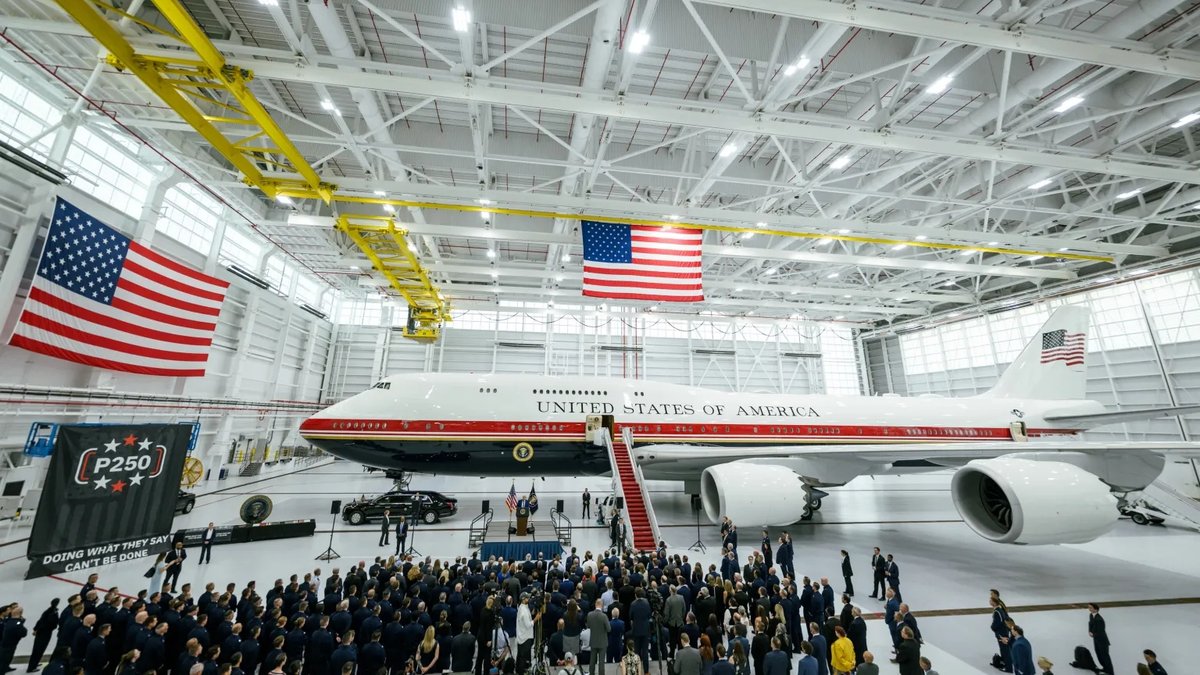
It arrived at Joint Base Andrews on June 19 to the strains of "God Bless the USA," and President Trump descended the stairs of a gleaming Boeing 747 painted in his personally selected red, white, and blue livery. The full story behind what the Air Force is calling the VC-25B Bridge aircraft is more complicated and more consequential for the long-term presidential airlift mission than the ceremonial unveiling suggested.
The Bridge aircraft exists because Boeing is behind on the delivery of two replacement VC-25B aircraft. The two purpose-built presidential transports that have been under development since 2018 - officially designated VC-25B - are now projected to arrive in mid-2028, years behind an original 2024 delivery target and perilously close to the end of Trump's second term.
In the meantime, the two aging VC-25A jets that have carried every president since George H.W. Bush in 1990 are still flying, but one is currently in extended maintenance.

Where the Plane Came From
The aircraft was originally built as a Boeing Business Jet 747-8 and delivered in April 2012, personally commissioned by Sheikh Hamad bin Jassim bin Jaber Al Thani - Qatar's former prime minister - and operated through Qatar Amiri Flight, the Qatari government's royal transport service. This was an unprecedented gift.
State-to-state transfers of military equipment are not unusual. Many countries still operate surplus US military equipment going back as far as WWII. However, this gift was not a transfer of state property from one government to another. Rather, this was a personal gift from a foreign royal to a sitting American president - a transaction with no modern parallel in the history of the office.
Qatar had been trying to offload the aircraft for years. A nearly identical 747-8 had been gifted to Turkish President Recep Tayyip Erdogan in 2018 after failing to sell, and this plane had been on the market since 2020 without finding a buyer. When the Trump administration expressed interest, Sheikh Hamad bin Jassim was solving a disposal problem. What he was giving away, however, was not a surplus corporate jet. Rather, it was an aircraft valued at roughly $400 million that would require nearly a billion dollars in modification costs drawn from the U.S. nuclear modernization budget to make it suitable for presidential use.
Valued at roughly $400 million based on the conversion price estimate from Air Force Secretary Troy Meink, the jumbo jet constitutes the largest unsolicited foreign gift ever accepted by the U.S. government. The acceptance generated significant political controversy. Democrats and ethics watchdog organizations argued the gift represented an unprecedented conflict of interest. Trump dismissed those concerns at the Joint Base Andrews unveiling, telling the assembled crowd that "only a fool" would turn down the world's most luxurious aircraft.
The legal and diplomatic arrangements surrounding the transfer have been notably opaque. Despite a Pentagon announcement in May 2025 that Defense Secretary Pete Hegseth had "accepted" the plane, the United States and Qatar had not yet signed a memorandum of understanding governing the transfer. According to media reports, Qatar sought an agreement making clear that the Trump administration initiated the deal and that Doha would not be responsible for future transfers of the aircraft. When pressed by senators on the cost and schedule of the conversion, Hegseth declined to provide details in open session - an unusual posture given that equivalent information on the main VC-25B program has always been publicly available.
After Trump's inauguration in January 2025, special envoy Steven Witkoff arranged for Qatar to send the plane to the U.S. for Trump to inspect at Palm Beach International Airport. At that point, Qatari officials were reportedly expecting the plane to be sold or leased to the U.S., not gifted.
What L3Harris Did in Ten Months
Once the Pentagon accepted the aircraft, the conversion work fell to L3Harris Technologies, a defense contractor based in Melbourne, Florida. L3Harris completed the conversion in just 10 months through around-the-clock operations across three shifts. Standard presidential aircraft overhauls typically take several years.
The full cost of the L3Harris conversion has never been officially disclosed. Air Force Secretary Meink told Congress the modification work would cost "less than $400 million" - a figure that raised immediate skepticism given the scope of work involved in securing a foreign-sourced aircraft for presidential use. That skepticism found some grounding in July 2025, when the New York Times reported an unexplained transfer of $934 million out of the Sentinel ICBM modernization program - the Air Force's nuclear missile replacement effort - into accounts associated with the presidential airlift work.
The Air Force did not reconcile the two numbers publicly, and Defense Secretary Hegseth declined to provide cost details when pressed by senators in open testimony. What is clear is that, however the accounting is structured, the bill for converting a foreign royal's surplus 747 into a presidential aircraft is being paid by the American taxpayer - with funds diverted from nuclear modernization.
A major portion of the time and cost involved stripping portions of the plane down to the literal cables to run forensic security audits, ensuring the foreign-sourced jet had no monitoring or recording devices installed. That step - essentially a counter-intelligence sweep of every system on a plane that had spent 13 years serving a foreign government - was not optional. Any aircraft designated Air Force One must be able to serve as an airborne command post. The possibility of embedded surveillance hardware in a gift from a Gulf state, however close an ally, was a security risk that could not be assumed away.
Even the paint job generated an engineering dilemma. Trump's preferred dark red-and-blue livery - the same scheme he had championed during his first term - posed a documented problem for the aircraft's belly, where communications antennas, mission systems, and specialized equipment are concentrated. Dark paint absorbs significantly more solar heat than light paint, and the Air Force warned in 2023 that a darker underside could push temperatures beyond the qualification limits of sensitive components, triggering a cascade of additional FAA certification testing, component requalification, and potentially structural redesign.
Biden had reversed the dark scheme in 2022 for exactly that reason. When Trump returned to office, the preferred colors came back, but the physics had not changed. The apparent resolution - visible on the first repainted C-32A executive transport - was a compromise: Trump's bold red, white, and blue on the upper fuselage, with a lighter treatment retained on the belly where the thermal engineering demanded it. The Air Force has not publicly confirmed whether the Bridge aircraft's underside received the same accommodation, as the full modification scope remains classified.
The Air Force was candid about what the accelerated timeline required in terms of tradeoffs. The press release from the Secretary of the Air Force Public Affairs office noted that modifications,
"...were carefully crafted to prioritize mission over aesthetics, leaving much of the previous head of state interior layout minimally changed. No risk was taken in security, safety or mission communications, but the collective team made trades on some of the less commonly used mission sets that Boeing must deliver to support the next 40 years."
In plain terms, the plane is secure and can communicate. Some of the more specialized capabilities that the permanent VC-25B fleet will carry are not yet installed. The Bridge is exactly what its name suggests - a capable but interim solution.
Secretary of the Air Force Troy Meink offered a more unambiguous assessment at the unveiling.
"From the beginning, we meticulously evaluated every requirement to accelerate delivery while maintaining the high standards expected of the presidential mission," Meink said.
"This effort proves that the U.S. Air Force can move fast without sacrificing quality, security, or reliability."
Air Force Chief of Staff Gen. Ken Wilsbach added:
"Many thought it could not be done, but the United States Air Force was able to execute and provide a secure, reliable airborne command post on an accelerated timeline."

Training, Commissioning, and What Comes Next
The aircraft's arrival at Joint Base Andrews did not immediately put it in service. The DVIDS release described commissioning flights as the "final exam" for the aircraft modification - an opportunity for the White House enterprise to validate mission capability while the Air Force finalizes the protocols required to safely and securely transport the president and enable him to execute his two constitutional roles as Chief Executive and Commander in Chief.
The training pipeline started in October 2025 with the lease of an Atlas Air 747-8F to begin training pilots and maintainers, followed by the purchase of a Lufthansa 747-8i as a full-time training asset for the entire crew complement. A full three-dimensional mock-up of the interior was delivered in January 2026, giving the White House enterprise the ability to begin familiarization training ahead of the Bridge's first commissioning flight.
The 89th Airlift Wing's Presidential Airlift Group at Joint Base Andrews will operate the Bridge aircraft alongside the two existing VC-25As and the C-32 fleet. An Air Force spokesperson confirmed that all aircraft remain available and that the Presidential Airlift Group will select the appropriate platform for each mission based on operational requirements.
The target for the aircraft's operational debut is July 4, 2026 - America's 250th birthday - when it is scheduled to lead a military flyover of Washington.
The VC-25B Bridge is expected to be retired shortly before the end of Trump's second term, with ownership subsequently transferred to the Donald J. Trump Presidential Library Foundation. That arrangement - a foreign-gifted aircraft entering the presidential fleet and exiting to a private foundation - has no direct precedent in the history of American presidential airlift.
The planned transfer to the Trump Presidential Library Foundation has been described as following the precedent set by the Reagan Library, which houses SAM 27000 - a Boeing 707 VC-137C that served seven presidents from Nixon through George W. Bush before being disassembled, trucked to Simi Valley, and reassembled as the centerpiece of Reagan's Air Force One pavilion. The comparison is superficially plausible but doesn't hold up under scrutiny. SAM 27000 was Air Force property throughout its service life, transferred through established channels after nearly three decades of presidential service to a library administered under the National Archives framework.
The LBJ Library sought a similar transfer of SAM 26000 - the Boeing 707 on which Lyndon Johnson was sworn in after Kennedy's assassination - and the Air Force refused, keeping it at the National Museum of the United States Air Force in Dayton, where it remains government property today. The Qatar plane presents an entirely different situation: a foreign royal's personal property, accepted as a gift, converted at classified cost using funds diverted from the nuclear modernization budget, flown for roughly two years, and then transferred to a private foundation bearing the sitting president's name.
The aircraft will almost certainly remain flyable when transferred - it will have accumulated only two years of service on an airframe maintained to Air Force standards - and while Trump has said publicly he does not intend to use it after leaving office, the disposition of a flyable, converted presidential 747 in the hands of a private foundation controlled by a former president has no precedent and raises questions no one in government has yet answered.
Congressional opposition amounted to symbolic protest - Senate Resolution 244, introduced by Sen. Richard Blumenthal, declared the acceptance an illegal emolument and demanded the plane remain permanent government property, while House Resolution 410, led by Rep. Jamie Raskin, called on Trump to seek congressional consent; both were referred to committee and died there, as Republican majorities declined to act.
The Boeing Problem That Made This Necessary
The Bridge aircraft would not exist if the main VC-25B program were on schedule. Boeing and the Air Force have attributed the delays and cost overruns on the permanent VC-25B fleet to higher-than-expected manufacturing costs, protracted negotiations with suppliers, supply chain issues, engineering changes, and shortages of skilled workers with security clearances. To be fair, these presidential aircraft are not new airplanes fresh from the assembly line in Seattle.
They are retrofits of two aircraft originally built for a now-defunct Russian airline and never delivered. The original delivery target for the fully operational VC-25Bs was 2024. The program slipped to 2027, then toward 2029, before the Air Force announced in late 2025 that mid-2028 was the revised target. Some of that delay was caused by accommodating the livery changes, and some by supply chain and labor issues, not to mention disruptions in Boeing’s aircraft business caused by the 737-MAX accidents.
An official 2023 Selected Acquisition Report showed the program's total acquisition estimate at approximately $5.73 billion, a figure that subsequently grew to around $6.2 billion. Boeing separately reported around $2.4 billion in losses on the contract, primarily because the deal was fixed-price and overruns hit the company's bottom line directly.
The fixed-price structure was itself a product of political pressure. Trump was intimately involved in the VC-25B contract with Boeing, tweeting in 2016 as president-elect that estimated costs were too expensive and personally negotiating the $3.9 billion deal with Boeing's chief executive after taking office in 2017. That contract, which locked Boeing into a price before the full scope of the conversion was understood, has proven costly for both the company and the program schedule.
To fund the Bridge aircraft conversion, Air Force Secretary Meink admitted to Congress that the Air Force diverted funds from the Sentinel ICBM program - the land-based leg of the nuclear triad - to pay for the work. That tradeoff drew criticism from lawmakers focused on nuclear modernization. The Sentinel program - the Air Force's long-delayed effort to replace the Minuteman III intercontinental ballistic missile, a weapon system that entered service in 1970 and has been patched, upgraded, and extended well beyond its intended service life - was already under severe cost and schedule pressure before a dollar of its budget was redirected to convert a Qatari royal's 747.
The program was restructured in 2023 under the Nunn-McCurdy Act after costs breached statutory limits, a designation reserved for programs whose expense has grown so far beyond original estimates that Congress must be formally notified - and the Air Force must justify continuing them at all.

What It Means for the Presidential Airlift Mission
For the men and women of the 89th Airlift Wing who will fly and maintain the Bridge aircraft, the immediate operational picture is actually straightforward: a newer, larger airframe joins a fleet that has been stretched thin by aging jets and heavy maintenance cycles.
The 747-8 platform is more modern than the 747-200B-based VC-25As by three decades of aviation development. Range, fuel efficiency, and interior volume all improve.
The longer-term picture is more complex. The permanent VC-25B fleet - when Boeing finally delivers it - will carry capabilities the Bridge does not: upgraded mission communications, more electrical power, enhanced self-defense systems, and autonomous ground operations designed for a threat environment that has evolved considerably since the VC-25As were designed in the 1980s.
The Bridge fills the gap. Whether it fully closes is a question the commissioning flights are designed to answer.
Continue Reading
Navy Pledges $1.7 Billion to Modernize Unaccompanied Sailor Housing
Baseball Caps and Collar Ranks: Army Considers First Major Uniform Update in Years
Faster Benefits, Better Jobs: New Executive Order Aims to Streamline Military Transitions
Join the Conversation

Mickey Addison
Military Affairs Analyst at MyBaseGuide
Mickey Addison is a retired U.S. Air Force colonel and former defense consultant with over 30 years of experience leading operational, engineering, and joint organizations. After military service, h...
Mickey Addison is a retired U.S. Air Force colonel and former defense consultant with over 30 years of experience leading operational, engineering, and joint organizations. After military service, h...
Credentials
- PMP
- MSCE
Expertise
- defense policy
- infrastructure management
- political-military affairs
SHARE: