When Words Fail: How Art Therapy Is Helping Veterans and Service Members Heal

Families with loved ones in the service or returning Veterans suffering from a traumatic brain injury (TBI) and associated psychological health conditions, including Post-Traumatic Stress Disorder, are often left confused about how to help, especially from the outside looking in.
We may even think the only way to help is to make sure they talk it out.
What we misunderstand is that a TBI resulting from an explosive blast does not just damage the brain physically; it fractures a service member’s ability to put their experiences into words.
When traditional talk therapy demands words that a service member cannot find, a different pathway to healing is essential. Creative arts therapy helps to solve this disconnect by allowing service members to communicate invisible wounds.
Process Over Product: Confronting the Blank Mask
To help bridge the gap between a family's confusion at home and a service member's recovery, active-duty personnel dealing with a TBI or PTSD may be referred to the National Intrepid Center of Excellence (NICoE), a specialized administration within the Walter Reed National Military Medical Center.
It’s here where service members enter a specialized, four-week intensive outpatient program. This interdisciplinary care program places medical experts, neurologists, and behavioral health providers under one roof.
Service members are exposed to modern wellness practices such as yoga and meditation to calm their nervous systems. In conjunction, they are also paired with professional creative arts therapists. It is within this clinical setting that patients are introduced to a modest tool for their recovery: a blank paper-mâché mask.
For elite service members conditioned to show absolute readiness, walking into an arts studio for help may seem far-fetched, as the high-readiness culture of the Armed Forces demands precision and perfection.
Lowering one's guard to admit to psychological distress goes against every piece of tactical training a service member has received. So, when they are handed a simple, identical paper-mâché mask, the immediate reaction for some may be met with deep skepticism.
To break down this defensive wall, clinicians reframe the exercise from a creative hobby into a behavioral health tool.
"We introduce what art therapy is, and that's when we kind of allow for them to understand that art therapy is not about being a good artist, and that it's not arts and crafts, and that we're what we like to say process-over-product oriented," explains Melissa Walker, the Healing Arts Program Coordinator and Lead Art Therapist at NICoE.
Service members learn tricks and techniques along the way, allowing them to dive in as deeply as they want. This shared experience transforms a group of isolated service members into a unified team, building an unexpected bond.
"It becomes like a community, really. And so they're like, 'Oh, that's me, that's us,'" Walker notes.
"Sometimes they even know other service members who have come through and created one. It's become this kind of visual community for them, lessens stigma, and lets them feel a little safer knowing that their buddies have come through and done this."
On display is a wall of masks created by peers who fought in the same fight, stripping the institutional stigma of mental health treatment. Safe within this visual community, service members realize they no longer have to endure in isolation. With their defensive guards lowered, they are equipped to work on complex hurdles such as a fractured sense of self.

The Split Identity: Gluing the Pieces Back Together
Service members undergo many changes. Whether that be continuous deployment cycles or the looming transition back to civilian life. There is a stark divide between their high-stakes military identity and their civilian or childhood self.
When these two lives feel completely incompatible, service members may experience an isolating psychological fragmentation, left wondering who they are outside the uniform and where they belong in the world.
This universal hurdle was vividly illustrated by a Special Operations service member who recently took part in the NICoE intensive outpatient curriculum.
Having spent years deployed all over the world, the operator initially met the mask-making instruction with deep hesitation. He explained to his care team that he felt disconnected from any support system, identifying himself as a "lone wolf."
He told clinicians that if he were to create a mask, it would not be a unified and connected face at all. Rather, it would be broken into "a thousand different pieces… just these little pieces of me everywhere," because he no longer knew what his community was or where he fit in it.
To tackle this sense of fragmentation, art therapists presented a physical and symbolic metaphor: Kintsugi, the traditional Japanese art of repairing broken pottery with a gold lacquer adhesive.
The crux of Kintsugi dictates that breakage and repair are meaningful parts of an item’s history, something to be honored instead of hidden away and discarded.
This concept resonated deeply with the operator. It was from there that he decided to paint two separate masks. The first depicted colors and symbols tying back to his childhood and global travels before his heavy combat years.
The second one told a different story, incorporating colors associated with his military experience, including his aviation squadrons and units. Once both were created, he purposefully divided the masks into fragments, and carefully reassembled the pieces using gold adhesive.
The simple but impactful act of gluing split worlds back together triggered a major cognitive shift.
"As he worked—and he was quite the perfectionist in his everyday life— it was really interesting to see him kind of let go a little bit and say, 'You know, it's not perfect, but that's okay, because nobody is, and it's just what this is. This is what it is,'" Melissa Walker recalls.
"But he got to take all these different pieces of himself and put them in one place, which I think for many of these service members, being able to kind of step back and process that, and all those different kinds of parts of their identities can be really impactful."
At the end, the operator’s mask had transformed from a symbol of a fractured life into a real-life testament to post-traumatic growth. Instead of tucking the mask away, he planned to hang it in his command office, using it as a visual representation to share his experiences with peers and show them that treatment works.
This shift from a fractured identity to an outward conversation spotlights the next hurdle many service members face: the inability to open up about what lies beneath the surface.

The Science of Silence: What the Masks Reveal
This inability to open up is not merely a defense mechanism; it’s a measurable clinical symptom of deep trauma and neurological disruption.
When a service member is exposed to an explosive blast, the resulting shockwave can cause microscopic damage to the brain's white matter. This physical trauma, frequently compounded by the psychological toll of PTSD, severely impacts the brain's language centers; specifically, Broca's area, the region responsible for speech production.
During traumatic recall, functional MRI scans have shown that Broca's area essentially shuts down, leading to a condition known as alexithymia, which is the literal inability to find words for emotions or experiences.
However, while the speech centers go offline, the brain's visual, spatial, and emotional centers remain highly active. This neurological reality is exactly why creative arts therapy works when traditional talk therapy stalls. Painting a mask creates a backdoor through the brain, allowing service members to bypass their damaged language pathways and express complex trauma visually.
To understand the science behind this phenomenon, a 2017 peer-reviewed study co-authored by Melissa Walker and colleagues analyzed 370 masks created by active-duty service members over a five-year period.
By qualitative coding, researchers proved that visual art reveals psychological and physiological patterns that traditional talk therapy misses.
The study showed recurring motifs that service members use to show their hidden wounds. To show the inability to open up, patients repeatedly painted themes of verbal restriction: stitched lips, heavy staples, gags, and literal padlocks bolted over the mouth. These symbols and motifs perfectly mirror the reality of trauma, displaying how a service member can feel trapped inside their own mind.
The 2017 research revealed how service members use the masks to express the physical distress of brain injuries. Service members frequently depicted their chronic, blast-induced migraines through imagery, such as cracks spiderwebbing across the mask, nails driven into the skull, or bloodshot, bleeding eyes representing tormenting hypervigilance. Because the injury literally stripped them of the vocabulary needed to articulate their pain, the art became their voice. The mask becomes a physical manifestation of the invisible wounds that no one else can see.
Service members are subjected to an endless cycle of clinical examinations where doctors repeatedly tell them everything that is wrong with their bodies and minds. Giving them a mask changes that dynamic by giving them the opportunity to take an active role in their own clinical assessment.
Ultimately, these pieces of art aren’t designed to remain hidden in an art studio. Instead, the mask serves as a discussion starter. By putting a physical face on the internal chaos, service members gain a safe, real-life tool to begin opening up to their medical teams, their peers, and most importantly, the families waiting for them at home.

Lifelong Recovery: Passing the Torch to the VA
The interdisciplinary care provided during a program like NICoE is vital, but healing from TBI and PTSD remains a lifelong journey.
When service members officially hang up their uniform and transition into Veteran life, the safety net of their military unit disappears.
To ensure service members don’t lose progress made in the clinic, the Department of Veterans Affairs (VA) picks up the mantle by expanding creative arts programs nationally for long-term community rehabilitation.
“VA programs like the National Veterans Creative Arts Festival facilitate Veteran healing and personal growth through engagement in the creative arts.
By fostering a collaborative space for creative expression, Veterans can process trauma, reduce stress and build community, supporting their mental and physical health and overall well-being,” explains Amy Kimbler, director of the National Veteran Creative Arts Festival.
Alternative therapies like glassblowing perfectly capture this change, translating the intensity of military service into a therapeutic civilian environment.
In a glassblowing hot shop, the environment is intensely sensory and undeniably dangerous. Veterans are surrounded by roaring furnaces operating at upwards of 2,000 degrees Fahrenheit, handling heavy steel pontil pipes tipped with glowing, molten glass. It is a high-stakes setting that requires acute situational awareness and hypervigilance; the very traits that often cause distress in a quiet civilian setting, but are suddenly repurposed here as vital assets.
Furthermore, in a hot shop, just like in a combat deployment, an individual cannot work alone; success requires trust and teamwork. The intricate dance of shaping molten glass demands seamless, often non-verbal communication between the lead glassblower and their assistants. If someone missteps, the piece shatters, or worse, someone gets burned.
The creative process itself can often mirror the military experience, balancing an element of physical danger and vulnerability with the creation of something beautiful. Veterans are able to rebuild the bonds of the barracks, processing shared trauma while creating a renewed sense of personal and even professional purpose. They are no longer isolated civilians struggling to adapt; they are once again part of a highly functioning unit, turning the fire of their past experiences into a tangible, beautiful future.
Finding a New Mission on Stage
The therapeutic power of the VA’s creative arts programs extends far beyond visual and tactile mediums. The National Veterans Creative Arts Festival also provides a national stage for performance. For many Veterans transitioning out of the military, the sudden loss of a defined mission and a cohesive unit can trigger a profound sense of isolation. The performing arts offer a way to replace that lost mission with a new, localized purpose.
When a Veteran picks up a guitar to write a song about a lost friend, or scripts a short play about the realities of coming home, they are engaging in a process functionally identical to the mask-making at NICoE. The rhythm, melody, and structure of a song provide a safe, manageable container for grief that might otherwise feel overwhelming. Music therapy taps into the brain's auditory processing centers, offering yet another neurological detour around the language blocks caused by TBIs and PTSD. A Veteran who cannot articulate their trauma in a clinical interview can often sing about it with profound clarity.
When these Veterans finally step onto the stage at the annual festival, they are not just putting on a show; they are testifying to their survival. The audience serves as the ultimate support system, validating the Veteran's experience in real time. It transforms private pain into a shared, public triumph, proving that the skills forged in the military can be successfully translated into civilian life.
Taking Control of the Story
The art created in these clinical studios, hot shops, and rehearsal spaces isn't meant to be hidden away in a closet.
When an active-duty Special Forces operator hangs a reassembled, gold-seamed mask on his command office wall, it tells a story to everyone around him. It cracks open a door that military culture usually keeps shut, giving his buddies permission to stop hiding their own struggles.
Similarly, when a Veteran stands on a stage to perform an original song about their deployment, or pulls a perfectly shaped glass bowl from a 2,000-degree furnace alongside their peers, they are proving that life after trauma is not only possible, but deeply meaningful.
By turning an invisible brain injury or a traumatic deployment into something you can actually see, touch, or hear, creative arts programs bridge the gap between military and civilian life. Whether they are still wearing the uniform or have long since transitioned out, art therapy gives service members and Veterans exactly what traditional trauma so often steals from them: a way to take back control of their own stories.
Continue Reading

Expressive Writing Therapy Is Healing Vets. Here’s How
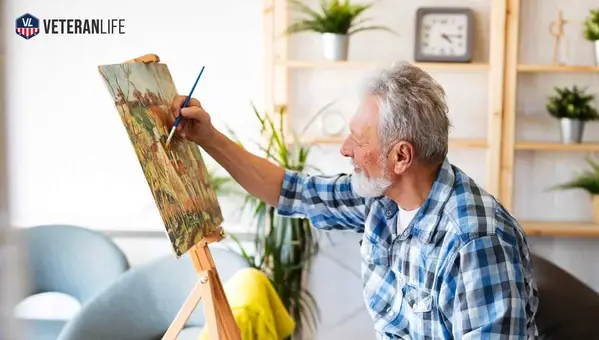
Veteran Art Programs Help Out Our Nation’s Heroes

Veterans Find Healing in Outdoor Activities: Nature Therapy
Join the Conversation

Michael Madrid
Military News & Gear Specialist at MyBaseGuide
Michael Madrid is a dedicated writer whose reporting brings clarity and authenticity to the stories of military members and their families. Having grown up in the shadow of Fort Bliss as the son of ...
Michael Madrid is a dedicated writer whose reporting brings clarity and authenticity to the stories of military members and their families. Having grown up in the shadow of Fort Bliss as the son of ...
Expertise
- Military News
- Military History
- Tactical Gear
SHARE: