Left Behind in Bahrain: Inside the Navy's Multi-Billion Dollar Basing Dilemma

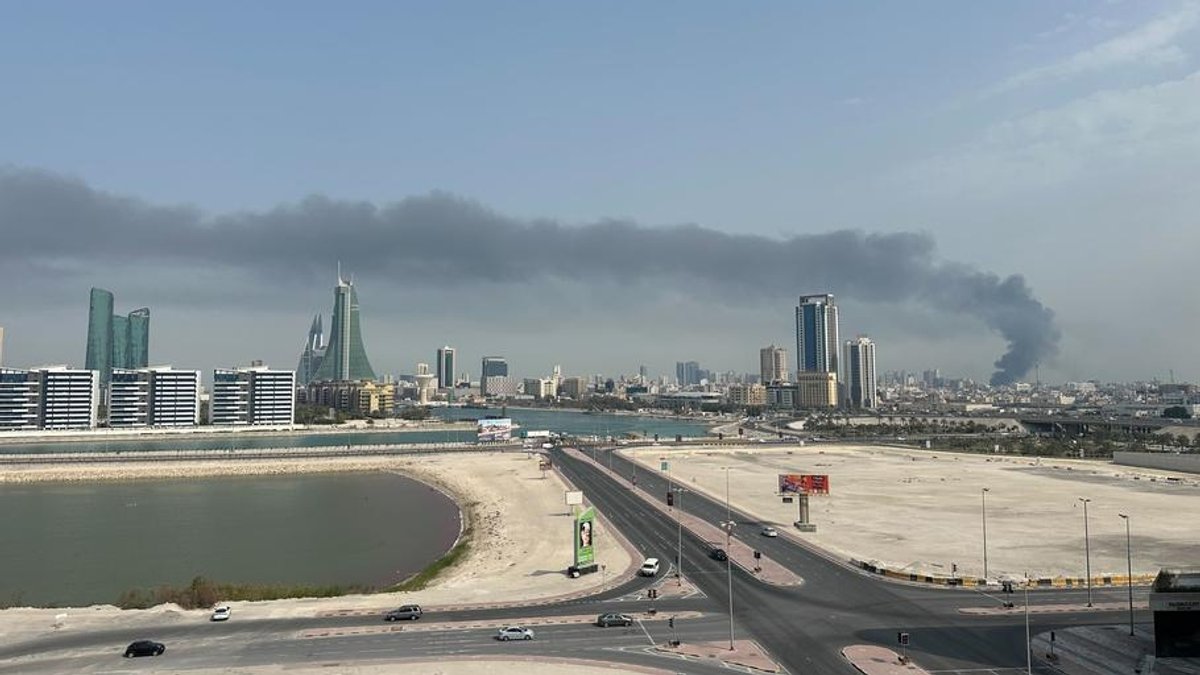
With the Iran War in its eighth month and no end in sight, American military planners are beginning to make long-term plans for force posture in the Gulf and across the Middle East. Two key questions that remain unanswered, at least publicly, are where the 5th Fleet headquarters will be and where the Central Command naval logistics hub will be now that returning to Bahrain seems untenable.
The Cost of War
In the opening days of the war with Iran, the Iranians fired more than 8,000 missiles and one-way attack drones, striking US and allied targets across the Middle East, according to the Wall Street Journal. Iranian missiles hit US and allied targets in the Gulf and as far away as Jordan and Iraq. Since the war began, 18 American military personnel have been killed and several hundred wounded.
The US naval base in Bahrain suffered significant damage in those first days, with the Bahrain Defense Forces reporting in March of this year alone that they had intercepted 125 ballistic missiles and 212 drones targeting the country. Satellite imagery obtained by The Wall Street Journal in June of this year showed the extent of the damage. At least 10 facilities were damaged or destroyed at NSA Bahrain. The damage included warehouses, training facilities, and a barracks, as well as the 5th Fleet Headquarters. The 5th Fleet is the naval component to US Central Command. The damage also included the destruction of a satellite communications facility near the 5th Fleet headquarters.
This past week, acting Secretary of the Navy Hung Cao gave some insight into how significant that damage really is, telling journalist Ryan Morgan that Iranian forces “blew the hell out of Bahrain.” The 5th Fleet headquarters relocated following the attacks in the first days of the war and is now operating from an undisclosed location or possibly dispersed locations. There are indications that at least some of the 5th Fleet’s headquarters are operating out of CENTCOM headquarters at MacDill AFB. Damage estimates to the installation vary.
The Pentagon has not released a figure for the estimated cost of damaged bases, and a review of the Fiscal Year 2027 President’s Budget military construction submittal now before Congress revealed no projects identified for Bahrain or Central Command. This tracks with Pentagon leaders’ statements, notably Jules W. Hurst III, Acting Under Secretary of Defense (Comptroller), who testified in May that the total cost of the war was $29 billion, not including facilities. When asked about military construction (MILCON) for the Middle East, Hurst replied,
“We have a lot of unknowns there. We don't know what our future posture is going to be. We don't know how we’d construct those bases, and we don't know what part our allies and partners could pay into the MILCON cost, and so we don't have a good estimate for that at the time.”
DoD has not broken the cost out for repairing base damage yet, but did request a supplemental appropriation from Congress for $87.6 billion. There have been independent estimates, however. The Wall Street Journal performed an in-depth investigation looking at satellite imagery, social media videos and photos, and firsthand accounts. Using the Pentagon’s publicly available cost model, the Journal estimated the damage to NSA Bahrain at $400 million. Mark Cancian (Colonel, USMCR, ret.), a senior advisor to the Center for Strategic and International Studies (CSIS) Defense and Security Department and Johns Hopkins School of Advanced International Studies, also performed an analysis.
In the CSIS report, Cancian estimated the total cost of the war at between $34.2 and $ 41.5 billion, with somewhere between $4 and $9.4 billion of that in base damage. The CSIS estimate is consistent with the American Enterprise Institute’s estimate of $5 billion for base damage and between $31 and $ 41 billion overall. Other estimates range from $40 billion to $113 billion.

How This Has Impacted Military Families
The evacuation of military families from NSA Bahrain was so fast that some were not able to bring more than what would fit in a backpack. Families left entire households behind, including personal electronics and, in some cases, pets.
Roughly 1,300 military families and several hundred pets were rapidly evacuated in what Navy officials believed at the time to be a short-term movement. That number does not include unaccompanied personnel and contractors, who were also evacuated. As reported by NPR, during a virtual town hall in August, the Navy’s 5th Fleet commander, Vice Admiral Curt Renshaw, spoke directly to families asking about their belongings. He acknowledged the distress felt by military families and explained that the operation has stretched longer than anyone anticipated.
He said, “Unfortunately, this has just stretched on and on, and has evolved into something greater and a bigger challenge."
Many, if not most, families have been in temporary living conditions since February. This means that nearly all their personal belongings, including clothes, pots and pans, bicycles, kids’ sports equipment, and cars, are still in their homes in Bahrain. U.S. Naval Forces Central Command (CUSNC) published guidance for reimbursing evacuees to Safe Haven locations (dated 2 May) shows that while families can expect some financial support, it does not cover all costs of displacement.
The first 30 days are reimbursable up to a maximum of 100% of the local per diem rate for those 12 and over (50% for those 12 and under), but after that it drops to 60% and 30%, respectively. What’s more, their Overseas Cost of Living Allowance (OCOLA) is reduced by $4/day after the 30th day in their Safe Haven location. The guide provides information on how to get reimbursement for long-term temporary quarters, and instructions on paying rent for their homes back in Bahrain. For many families, the length of the displacement means buying entirely new wardrobes, outfitting new kitchens and baths, and even buying or leasing cars. Evacuees and their sponsors should keep every receipt and regularly connect with their command team to ensure they have the latest information. The CUSNC website is being continually updated.
Now, after months of limbo, the situation seems to be changing. According to DefenseScoop, on August 27, Under Secretary of Defense for Personnel and Readiness Anthony Tata and his deputy Sean O’Keefe sent a memo to Pentagon leaders concerning the status of the evacuees and their belongings. Since a Noncombatant Evacuation Operation is a State Department-led event, it is governed by law and cannot be extended past 180 days for reimbursement.
The memo seems to grant dependents options to retrieve their household goods, terminate the Stop Forward Movement order, and begin the process of the Pentagon taking the lead from the State Department. During an August 31 worldwide town hall, Chief of Naval Operations Admiral Daryl Caudle emphasized that he is “working hand in hand with Vice Admiral Curt A. Renshaw to develop a plan for members to get their stuff.”
The expectation in both the memo and the CNO’s public statements is that members will land, pack out, and leave in an orderly and as rapid a manner as possible. Families will not be returning to Bahrain any time soon, so this memo and plan to retrieve household goods is essentially an unplanned PCS for families stationed there.

How Theater Logistics Has Changed
Prior to the Iran War and the subsequent damage to NSA Bahrain, the port at Manama, Bahrain, was a crucial hub for fleet logistics in the Persian Gulf and Arabian Sea. Ships like the USS Abraham Lincoln and her strike group would make port there for liberty for the crew and replenishment of supplies. When making port was not an option due to operational needs, underway replenishment ships would stock up on supplies and fuel, then make their way to ships on station.
Once the Strait became too dangerous to transit and the ports in the Gulf were damaged, the Navy switched its logistics hub to Diego Garcia, 2,385 nautical miles away, and Singapore, even further away. This turned a trip for a replenishment ship from a couple of days’ transit from Manama to the carrier’s station in the Arabian Sea into a 10-day round trip.
Maritime and naval expert Dr. Sal Mercogliano described decisions made decades ago that exacerbated the dilemma facing the Navy today, namely the consolidation of auxiliary ships under Military Sealift Command.
At the end of the Cold War, he noted that the Navy “replaced Navy-crewed auxiliary ships with civilian-crewed Military Sealift Command vessels, merging 'station' and 'shuttle' fleets and reducing overall capacity.”
The capacity is much smaller than the Cold War Navy, and built around a deployment concept based on ports close to the combat area. Once close bases on the Arabian Peninsula became untenable, the Navy’s auxiliary fleet became significantly stressed. Combat operations such as those conducted against Iran consume vast amounts of food, fuel, sundries, and munitions as well as a host of other consumables from shaving cream to clothing. Long steaming times for underway replenishment mean longer times between resupply, and that translates into lower levels of everything aboard ship.
Complicating the logistics process is warehouse space, especially refrigerated warehouses for food and temperature-sensitive supplies, which are limited in some ports. NSA Bahrain was built up over decades as the main hub in the Middle East, and it was a successful strategy in an uncontested environment. Now that Iran has demonstrated it can hold bases in the Middle East at risk, the Navy has been forced to make adjustments. To begin closing the gap, the Navy has activated one of the five National Security Multi-Mission Vessels (NSMV), in this case the Empire State VII, which usually serves as a training ship for the SUNY Maritime College. It’s expected the vessel may be used to provide additional berthing for Sailors making port for liberty at Diego Garcia. It could also be used to help shuttle people from Diego to another location.
The Future Remains a Question
With the Iran War dragging on without a resolution in sight, two things are clear: no speedy return and a complete rethinking of the Navy’s logistics system in the Middle East.
Based on the lack of repair dollars for Middle Eastern bases in the draft FY2027 NDAA, 2028 appears to be the earliest return date possible, with 2029 or later seeming equally or more likely. Rebuilding air and naval bases in the Middle East may end up costing the United States a great deal, and the conversations between Capitol Hill and the White House will determine whether that cost is worth it.
The Navy will need to significantly rethink and retool its logistics system in the CENTCOM Area of Responsibility, and probably re-evaluate the auxiliary fleet capacity. The current logistics hubs in Diego and Singapore are a long way from the Gulf. That offers a measure of safety from missile and drone threats, but complicates replenishment underway. The solution is likely a combination of new ports and more auxiliary ships.
The war the administration and the Pentagon expected to last weeks has so far lasted months, and with no end in sight, a wholesale reevaluation of force posture, logistics, and how US forces work with allies is underway. The full cost will not be known for some time to come.
Continue Reading
Understanding VEERP: The USMC’s 2026 Early Separation Program Explained

Why the US Is Weighing MOAB Deployment in Iran After the Midterms

30+ Things to Do Near Redstone Arsenal in Huntsville, Alabama
Join the Conversation

Mickey Addison
Military Affairs Analyst at MyBaseGuide
Mickey Addison is a retired U.S. Air Force colonel and former defense consultant with over 30 years of experience leading operational, engineering, and joint organizations. After military service, h...
Mickey Addison is a retired U.S. Air Force colonel and former defense consultant with over 30 years of experience leading operational, engineering, and joint organizations. After military service, h...
Credentials
- PMP
- MSCE
Expertise
- defense policy
- infrastructure management
- political-military affairs
Calculate Your BAH
Planning your housing budget? Use our 2026 BAH Calculator to see your Basic Allowance for Housing rates for your base.
Calculate BAH Rates →SHARE: