Army Ends Anonymous Harassment Reporting, Shifting Power Back to Commanders

The Army is overhauling the way it handles discrimination and harassment complaints, eliminating the option for soldiers to file anonymous allegations and giving commanders broader authority to dismiss the complaints they do receive.
The change, detailed in an Army-wide message published in August 2026 and set to take effect once a revised regulation is formally issued in the coming months, ends anonymous reporting through the Military Equal Opportunity (MEO) program (the office that investigates complaints of discrimination and harassment tied to race, sex, or religion). Soldiers will still be able to file "confidential" complaints, meaning their identity will be withheld from their command unless a safety threat emerges or a law requires disclosure. But every complaint will now have to be attached to a name before the Army will act on it as a formal case.
Commanders retain the discretion to investigate anonymous tips that come in through other channels if the information is specific enough to justify a look. What they will no longer do is process and formally track anonymous complaints through the MEO system itself.
The policy is part of a broader rewrite of Army harassment and discrimination rules that also shortens the window soldiers have to file a complaint, gives commanders new authority to dismiss complaints outright, and narrows the legal definition of harassment to exclude "official military or governmental activities conducted in a professional manner." This includes basic training, physical fitness testing, and disciplinary actions.
The changes track a Pentagon-wide directive from Defense Secretary Pete Hegseth, who has argued for more than a year that the MEO complaint system has been misused. In an April 2025 video posted to X, Hegseth said the department's equal opportunity programs are "a good thing" in principle but that "some individuals use these programs in bad faith to retaliate against superiors or peers." He later told a gathering of the military's generals and admirals at Marine Corps Base Quantico that the department would no longer tolerate service members "walking on eggshells," the phrase that has since become shorthand for the policy inside the Pentagon.
At Quantico, Hegseth drew a hard line between behavior he called illegal and behavior he said should never have been treated as a violation in the first place.
"Racism and sexual harassment are wrong and illegal, and we will continue to stamp them out — ruthlessly," he told the assembled officers, according to a transcript of the address.
But, he continued, "telling someone to shave or get a haircut or to get in shape or to fix their uniform or to show up on time, to work hard, that's exactly the kind of discrimination we want."
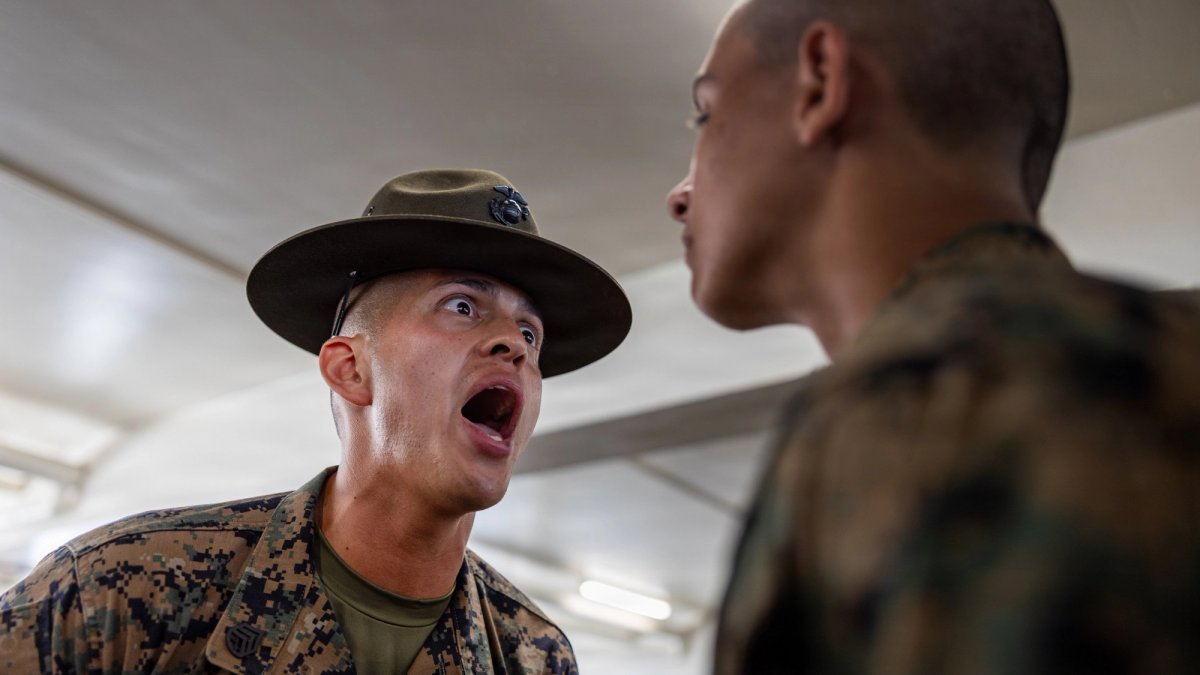
Hegseth used the same address to preview changes to basic training that have since been folded into the broader policy rewrite. He told commanders he wants boot camp to be "scary, tough and disciplined" again, and that drill sergeants should be free to use methods that had fallen out of favor.
"Yes, they can shark attack, they can toss bunks, they can swear, and yes, they can put their hands on recruits," he said, adding that none of that amounts to a license to "be reckless or violate the law."

What Actually Changes
The Army's new policy, first reported by Task & Purpose, does more than remove anonymous reporting. It compresses timelines and hands commanders new tools to close out complaints without a full investigation.
Under the revised rules, a complaint can be dismissed within 14 days if the Army determines it lacks "sufficient or actionable information," or if it was filed more than 60 days after the most recent incident. The Army is also formally building out alternative dispute resolution, encouraging mediation and facilitation as a first step "before they escalate," rather than a formal MEO investigation. When both parties reach an agreement through that process, a mediator drafts a memorandum documenting the terms and any follow-up actions.
The policy carves out three categories that keep their existing protections: sexual harassment, hazing, and bullying, all of which fall under separate federal statutes.
Soldiers can still report those anonymously. The Army has, however, broadened its definition of bullying to explicitly include cyberbullying; posting "malicious gossip, rumors and lies" on social media, sharing humiliating photos, or sending "vicious texts."
The policy applies Army-wide, including to soldiers in the National Guard and Army Reserve.
At a Glance: Old Policy vs. New Policy
'We're Going to Give It All Back to the Commanders'
Rachel VanLandingham, a military justice expert and former Air Force lawyer, said the Army's rewrite reflects an attempt to reconcile Hegseth's sweeping directive with the narrower set of protections that survive in federal law. She described the policy as an effort to "square Hegseth's overly broad directive" with "commander's intent while complying with federal law in these specific areas."
Because commanders already controlled what discipline, if any, followed an MEO investigation, VanLandingham said the practical effect of the new policy is less about the outcome of any single case and more about signaling where authority sits going forward.
"We're going to give it all back to the commanders. That's the underlying tenor," she said.
"This really comes down to what's being undercut here because it doesn't have the statutory protections that hazing and bullying and sexual harassment textually specifically do."
VanLandingham was also emphatic that anonymous and confidential reporting are not interchangeable safeguards, despite how the Army has framed the substitution.
"There is a huge difference between anonymous and confidential reporting," she said.
"It's basic best practice across professional militaries to have anonymous reporting mechanisms, given fear of retaliation from the command chain — service members are quite vulnerable to such retaliation, given the military's hierarchical structure in which commanders and the command chain have influence over so much of a service member's life and future career. It should be preserved for all complaints."
Gary Barthel, a retired Marine Corps lieutenant colonel and military justice lawyer, said the policy's broader effect is to widen the space in which commanders can choose not to act.
"They're trying to give the commands more lenience in investigating what they feel they want to investigate, and they can dismiss whatever they feel is not credible," Barthel said.
He noted that the previous system had built-in political pressure that pushed commanders toward investigating complaints even when they were skeptical of them.
"In the past, commanders and commanding generals have always taken the step that 'Hey, I'm going to investigate this because I know if I don't, Congress is going to be all over me because somebody made a complaint and they're feeling like it was swept under the rug.'"
Barthel was more sympathetic to the Army's decision to formally define cyberbullying, calling it a useful update "given where we are in society."
'Walking on Eggshells' in the Other Direction, One Critic Argues
VanLandingham pushed back directly on the premise behind Hegseth's "no more walking on eggshells" framing, arguing that most commanders were never the problem the policy is aimed at — and that the change could end up protecting the small number of troops whose conduct prompted complaints in the first place.
"Good commanders, which are the vast majority, understand that any type of harassment, bullying, discrimination based on racial, ethnic, religious, gender, sexual orientation, etc. lines are harmful to good order and discipline and will work to prevent it regardless of the bigotry and anti-leadership coming from the Hegseth regime," she said.
"Yet the few insecure twerps in uniform whose fragile manhood is threatened by women, African Americans, and anyone not like them will complain they've been unfairly treated when commanders take necessary action to hold them to account."
That dynamic, she argued, cuts against the policy's stated purpose.
"I think this policy emboldens the corrosive few who degrade units through their bad behavior, and makes commanders' jobs more difficult as they will now be walking on eggshells in the opposite direction — in fear of being labeled woke simply because they held mini-Hegseths in their units accountable for racial, sexual or other bad behavior," VanLandingham said.
"And fear of their own careers not progressing because they are seen as not following the harmful party line."
Neither the Army nor the Department of Defense has addressed that characterization directly. Army officials describe the policy's purpose in narrower terms: reducing formal complaint volume and resolving disputes through mediation before they escalate.

The Training Floor Carve Out Draws the Sharpest Criticism
The provision generating the most pointed pushback is the exemption for "professional" military activities — the clause that shields conduct during basic training, physical fitness testing, and disciplinary actions from being classified as harassment, so long as it's "conducted in a professional manner."
VanLandingham called the redefinition of harassment an attempt to "intentionally broaden the scope of what's allowable and to limit the scope of what could be punishable." She argued that some of the military's most serious hazing and bullying cases have unfolded precisely in the training environments the new policy sets apart.
She pointed to the case of Raheel Siddiqui, a Marine Corps recruit who was forced into a clothes dryer during boot camp at Marine Corps Recruit Depot Parris Island, South Carolina, in 2016. A subsequent Marine Corps investigation found that Siddiqui had been subjected to anti-Muslim slurs and physical abuse before he took his own life.
"You can't have bullying without having harassment," VanLandingham said.
"One of the most common places is during basic training, so don't tell me: 'Well, if it's conducted in a professional manner or such as basic training, it's not harassment.' It may well be because you didn't define what 'professional' here is. Just being in basic military training doesn't inoculate and immunize behavior — in fact, that's where you have some of the highest risk of harassment."
VanLandingham said the military already has a workable test for separating legitimate training rigor from misconduct, and that the new carve-out sidesteps it rather than applying it.
"The military knows the difference between harassment and other cruel, inhuman and degrading treatment, versus military training that is needed to prepare our service members for arduous wartime conditions," she said.
"For every act or statement: is it militarily necessary? How so? Or is it simply degrading? This new guidance cannot pretend to exempt our professional activities from U.S. equal protection law, as well as related criminal law — as much as this administration wants to try."
A Defense Attorney's View: 'It Cuts Both Ways'
Cody Harnish, Esq., an attorney and National Institute of Military Justice fellow who served as an enlisted soldier before commissioning as an Army JAG officer, offered a more mixed assessment of the rewrite; one that credits it with addressing a due-process problem he says he's seen repeatedly in his own practice, even as he cautioned against reading the new definitions as a uniform loosening of standards.
Harnish said he has represented commanders and noncommissioned officers removed from their positions pending investigation after a complaint later proved to be retaliatory.
"I've represented many clients who are an NCO or a commander and a junior enlisted individual is upset with their leadership — or more likely upset with being held accountable to legitimate leadership concerns and issues — will then make a complaint, and then the commander is then removed from command while they're under investigation," he said.
"Only to find out that it was in fact a disgruntled junior enlisted soldier who did not like being held to the standard."
That scenario tracks closely with the kind of case Hegseth has pointed to in describing MEO complaints as sometimes "used in bad faith to retaliate against superiors or peers." It's part of why Harnish sees the new definitions as more balanced than critics of the policy acknowledge — though he stopped short of calling them uniformly narrower.
"I think it cuts both ways," he said. "This is a benefit to maybe the due process requirements of individuals who are under investigation, but there's also — when you look into it, the devil's always in the details. The definitions are getting some real elements for the first time."
Under the new policy, he said, bullying will require "a repeated pattern of conduct that exploits a power imbalance," meaning "one bad day or one harsh counseling session categorically won't qualify anymore." Harassment, meanwhile, will be measured by "a reasonable person standard in a military environment" — a change Harnish called significant.
"It's an expressed carve-out for tough training, PT, corrective action," he said.
"The policy now says in writing that rude and abrasive behavior is not automatically harassment. The Army is drawing the line that it's never clearly drawn before, that demanding leadership is not misconduct."
But Harnish said hazing complaints could actually become easier to substantiate under the rewrite, since the new definition introduces a recklessness standard rather than requiring intent.
"The way it looks like it's going to define hazing, hazing gets modestly easier to substantiate. Recklessness will now suffice," he said.
"They're not uniformly narrower definitions. ... Bullying is narrowed, but hazing is a little more broad with the recklessness standard."
A soldier doesn't have to mean for harm to occur to be found reckless, he explained — only that they "should have known that it was going to have foreseeable consequences."
Harnish was less convinced the rewrite would address a separate problem he says he encounters often in his defense practice: service members who file false statements during an MEO investigation.
"I've seen people take advantage of the system," he said. "I have never seen any accountability for individuals taking advantage of the system and making false official statements, even in my current practice when we have demonstrable evidence that what they're saying is a lie. All of these pending changes on where we're going to do credibility analysis and we're going to go after people for false official statements — I'll just say that I'm not going to hold my breath."
Like VanLandingham, Harnish said any assessment of the policy remains provisional until the Army publishes the underlying regulatory text.
"We still don't know the actual policy language yet that they're going to publish later this year," he said. "Right now, it's just going to be words on paper."
How the Policy Took Shape
What Happens to Reporting Rates?
None of the officials or experts contacted disputed that the new system will change soldiers' calculus about whether to come forward. What remains unsettled is whether attaching a name to every complaint, even a confidentially handled one, will suppress the number of soldiers willing to report discrimination in the first place.
VanLandingham argued that suppression is already underway, and ties it to what she described as a broader pattern under Hegseth.
"The entire tenor of the Hegseth reign of terror in the Pentagon is to create a white male straight Christian military, and his words and actions encourage harassment of and discrimination against those that don't fit that mold," she said.
"There already has been a chilling effect regarding complaints, and surely that will only increase. Hegseth's numerous attempts to remake the military into his own sophomore toxic masculinity reflection is a terrible step backward and hurts the military and hence U.S. national security. It's laughable if it wasn't so deadly serious."
That assessment is VanLandingham's characterization, not a finding the Army or the Department of War has confirmed or disputed on the record. The department maintains that the policy is meant to curb bad-faith use of the complaint system, not to discourage legitimate reporting.
The Army has framed the change as a shift toward "efficient" resolution: catching disputes early, through mediation and facilitation, before they escalate into formal investigations that can take months and strain unit cohesion. Whether soldiers experience that shift as a faster path to resolution or as a narrower door for legitimate complaints to get a hearing may not be clear until the policy has been in effect for a full reporting cycle. The 14-day dismissal window and 60-day filing deadline give commanders tools they didn't have before to close cases quickly, for reasons that will not be uniformly applied across major commands.
Advocates for service members have raised a related concern: that removing anonymity, even when replaced with confidentiality, could deter troops who fear that filing a complaint will still become known within a small unit, where soldiers often work in close daily contact with the people they might be reporting.
The Army has said the confidential-reporting option is designed to address exactly that risk, by allowing soldiers to come forward without triggering an investigation or notifying their command. Whether that distinction holds up in practice, particularly in small units where identifying details are hard to fully obscure, is likely to be one of the first things outside observers and lawmakers scrutinize once the regulation takes effect.
What to Watch Next
- Publication of the formal Army regulation. The ALARACT message previews the policy, but the Army has not yet published the full regulatory language that will govern implementation, definitions, and appeals.
- Congressional response. Military discrimination and harassment policy has drawn sustained congressional interest in recent years, including legislation aimed at setting hard deadlines for complaint processing. Lawmakers on the House and Senate Armed Services Committees are likely to seek briefings on the change.
- Data on complaint volume. The Army has not released projections for how the policy will affect the number of complaints filed or substantiated. Advocacy groups and watchdogs are expected to press for that data once the policy has been active for a reporting period.
- How "confidential" holds up in small units. Whether soldiers in company- and platoon-sized units believe their identities can realistically stay protected will shape whether the confidential-reporting option functions as intended.

Join the Conversation

Tracy Fuga
Military Spouse & Military Lifestyle Writer at MyBaseGuide
Tracy Fuga is a San Diego-based writer, editor, and marketing professional with nearly two decades of experience in content creation and communications. A former editor at MARCOA Media — the origina...
Tracy Fuga is a San Diego-based writer, editor, and marketing professional with nearly two decades of experience in content creation and communications. A former editor at MARCOA Media — the origina...
Expertise
- military spouse lifestyle
- small buisness
- entrepreneurship
SHARE: