THE SACRED JOURNEY HOME: DIGNIFIED TRANSFERS AND THE DOVER PORT MORTUARY
There is a scene in the 2009 HBO film Taking Chance that tells the story of how the military takes care of its own - in a few short minutes, with almost no dialogue. The movie is adapted from an essay by Marine Lt. Col. Michael Strobl, played by Kevin Bacon, as he escorts fallen Marine Private First Class (PFC) Chance Phelps home. The casket will be closed - PFC Phelps's body is not suitable for viewing, so no one will see what is inside. And yet Strobl insists on opening it anyway, because he needs to verify that the uniform is squared away.
Despite it being a closed-casket ceremony, he insists on making sure PFC Phelps's uniform is correct and in place. As the men open the casket, both Marines have a strong emotional reaction. Strobl remarks that even though the staff at Dover Port Mortuary knew it was going to be a closed-casket ceremony, they still made every effort to make sure that PFC Phelps was prepared and dressed perfectly.
His uniform was immaculate, a tribute to the professionalism of the personnel at Dover. He wore six ribbons over his marksmanship badge; the senior one was his Purple Heart.
Taking Chance was a dramatization of an essay written by Lt. Col. Strobl about his experience as an escort for PFC Phelps, and it is an excellent window into that last solemn journey of a fallen servicemember to their home. What you see on screen is what actually happens at the Charles C. Carson Center for Mortuary Affairs, operated by the US Air Force at Dover Air Force Base, Delaware.

First Stop: Dover
The Port Mortuary was established in 1955 at Dover Air Force Base. Today it finds its home inside the Charles C. Carson Center for Mortuary Affairs, a 73,000 square foot, state-of-the-art facility built in 2003 at a cost of $30 million. Every American service member who dies in overseas operations comes here first, regardless of branch. The facility also cares for the remains of other Americans, such as the crews of the Challenger and Columbia space shuttles.
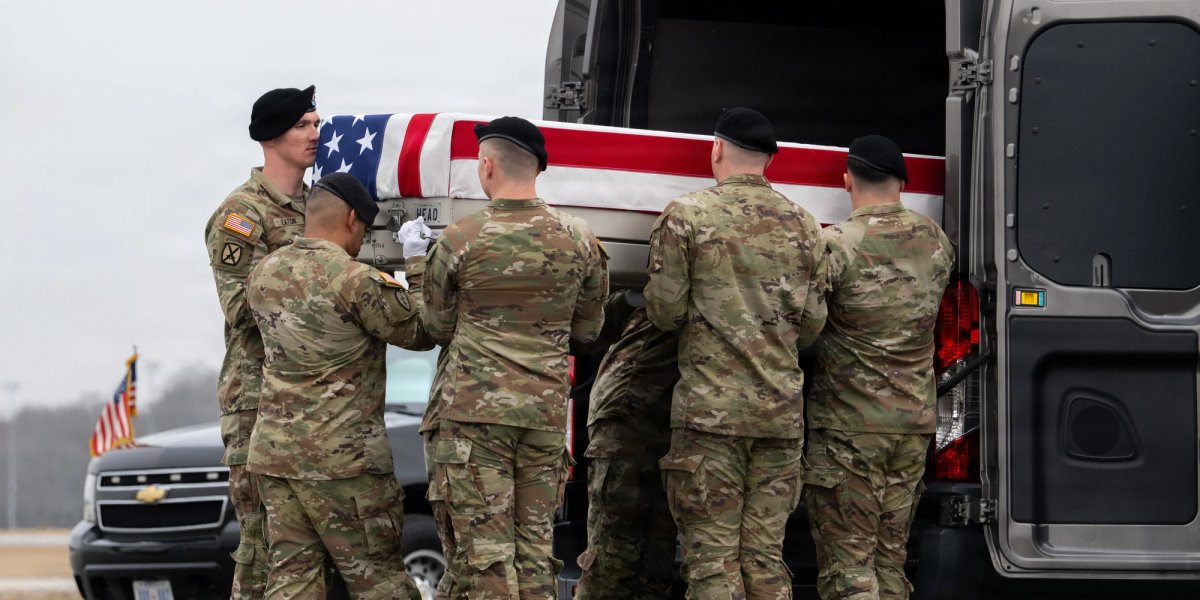
A dignified transfer is conducted for every U.S. military member who dies in a theater of operations. The most visible dignified transfers happen at Dover, but the same process is repeated each time a fallen servicemember is transferred from one aircraft to another.
A senior ranking officer of the fallen member's branch of service presides over each dignified transfer, with a carry team made up of members of the same branch. The remains arrive flag-draped and are carried - not transported, carried - by hand from the aircraft to the mortuary vehicle in silence.
Inside the Carson Center, the real work begins. Blood and grime are scrubbed from dog tags, watches, and other personal effects. Hands are carefully cleaned, though they will be concealed by white gloves. Uniforms and medals are meticulously arranged - even in cases of closed-casket funerals.
Their mission is to provide dignity, honor, and respect to the fallen - this is the last memory those families will have of their loved ones. The people doing this work are licensed funeral directors, military specialists, and volunteers who understand that this is not a job. It is a covenant, and the silent final rendering of respect to one who has given their life in the service of the country.
The Journey Continues
Once preparation is complete, an escort - a uniformed service member, often a volunteer - travels with the fallen from Dover to their final destination.
The escort is responsible for the remains at every transfer point, renders honors every time the casket moves, and serves as the personal representative of a grateful nation until the very end. That responsibility extends to every hand the fallen passes through along the way.
Airlines and airport personnel are part of this story too. Ramp crews pause their work; aircrew make announcements. Baggage handlers who handle hundreds of pieces of cargo every day treat this one differently, because they know. Many of them are Veterans themselves. Most major airlines have an honor guard of volunteers who render honors and have a flag present.

The People Around the Family
Death in the military is ever-present. The work is dangerous even in peacetime: training accidents claim lives every year. For many, one of the first things they do upon entry into the service is write out their will. When a servicemember falls, the family is notified by a casualty notification team. An officer and a chaplain from the nearest installation will get the call and make the notification as quickly as possible. A Casualty Assistance Officer (CAO for the Army, or Casualty Assistance Calls Officer/CACO for the Navy and Marine Corps) is assigned immediately, serving as guide, advocate, and human connection through a process that can feel overwhelming.
The Family Assistance Representative (or Casualty Assistance Representative/CAR in the Air Force and Space Force) from the fallen servicemember's unit is alongside throughout, helping the family navigate benefits, paperwork, options, and decisions no one should have to make while also trying to grieve.
Following the 2009 National Defense Authorization Act, the Department of Defense now invites families to travel to Dover at government expense to witness the dignified transfer of their loved one. Furthermore, a massive policy shift enacted in April 2009 by then-Secretary of Defense Robert Gates lifted the long-standing media blackout on dignified transfers, allowing press coverage if the families consent.
They will not see the remains themselves at this stage, but they will see the flag-draped transfer case carried by their loved one's branch, with full honors rendered. For some, this makes their loss real for the first time.
Final Honors
An Honor Guard, drawn from the nearest installation of the fallen's service, accompanies them to the final resting place. Sometimes that means National Guard or Reserve forces mobilize to ensure the fallen servicemember and their family are rendered the honors they deserve. The honor guard will render whatever honors the family has requested: from a full military funeral with a firing party, to a graveside ceremony with flag presentation, to something quieter and more private.
The flag is folded thirteen times and is presented "on behalf of the President of the United States, the [service], and a grateful nation." Those words are not mere script, but the final heartfelt thanks and farewell from comrades.
Taking Chance was the most-watched HBO original in five years when it aired in February 2009. Former Secretary of Defense Robert Gates wrote in his memoir that the film had an "important impact" on his decision to allow media access to dignified transfers at Dover.
The dignified handling of the remains of fallen servicemembers, as well as rendering the proper military honors, is more than mere tradition. It is a moral obligation, executed with a precision and tenderness that would be remarkable in any context, and is extraordinary in the context of war. From the NCO at Dover who squares away a uniform no one will ever see, to the ramp worker who pauses in the rain, to the Honor Guard who renders a final salute at a grave in Wyoming or Texas or Ohio - this is a country honoring its word to those who kept theirs.
Suggested reads:
Join the Conversation

Mickey Addison
Military Affairs Analyst at MyBaseGuide
Mickey Addison is a retired U.S. Air Force colonel and former defense consultant with over 30 years of experience leading operational, engineering, and joint organizations. After military service, h...
Mickey Addison is a retired U.S. Air Force colonel and former defense consultant with over 30 years of experience leading operational, engineering, and joint organizations. After military service, h...
Credentials
- PMP
- MSCE
Expertise
- defense policy
- infrastructure management
- political-military affairs
SHARE: